






Transform your business through your employees
Centralus provides simple and employee-focused solutions designed to boost engagement and reinforce your business through
· Free, amazing VIP Benefits only big companies can afford
· Streamlined Payroll Consultancy Services
· Expert Workplace Pensions Administration
· Inclusive Employment Law Advice
Companies with high employee engagement achieve:



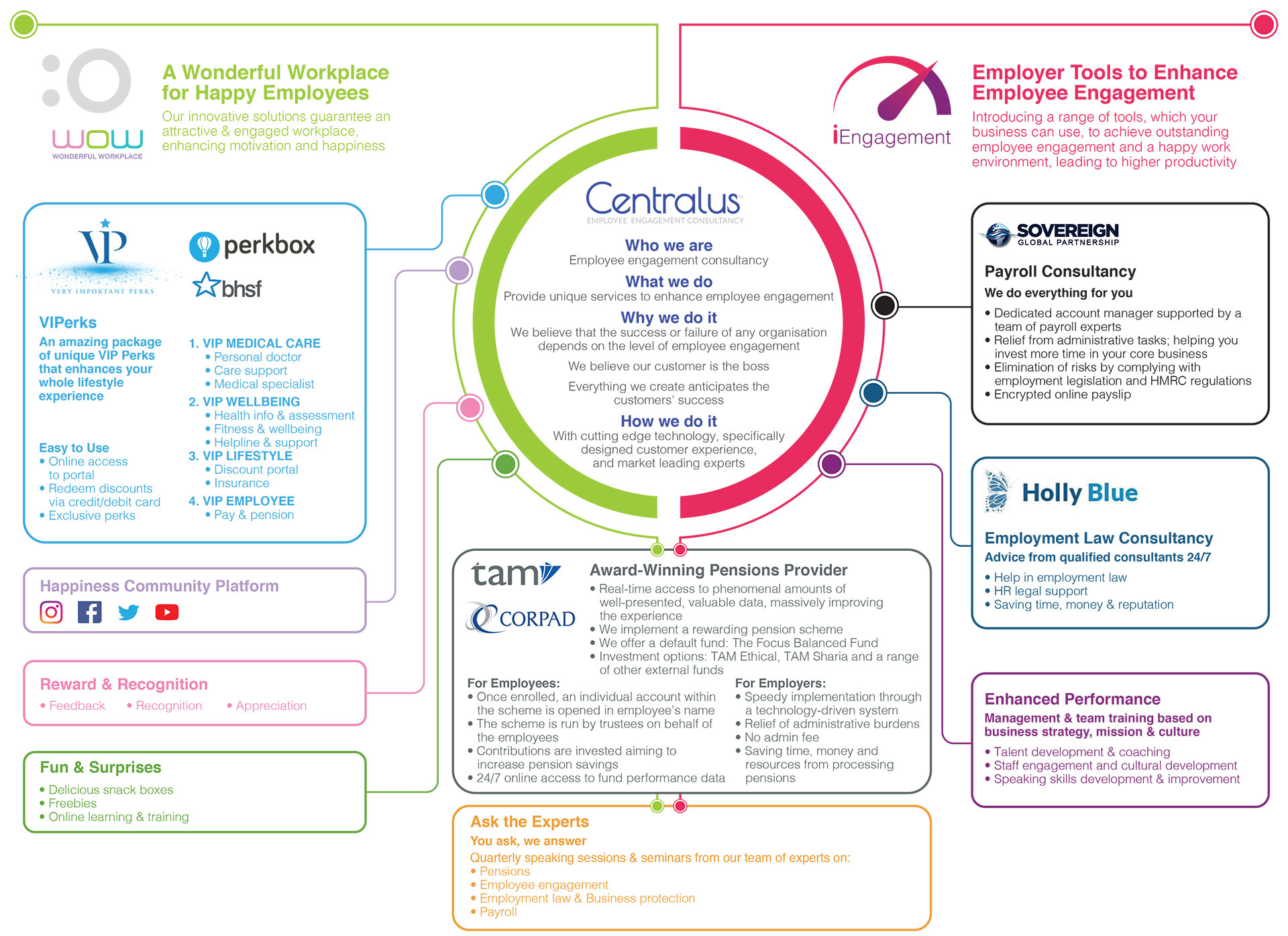
Our services are now reinforced with a whole new suite of products and services that help us make your workplace the place your employees go the extra mile with a smile! We introduce two brand new products: WOW – The Wonderful Workplace and iEngagement.
Centralus provides simple and employee-focused solutions designed to boost engagement and reinforce your business through
· Free, amazing VIP Benefits only big companies can afford
· Streamlined Payroll Consultancy Services
· Expert Workplace Pensions Administration
· Inclusive Employment Law Advice
Companies with high employee engagement achieve:
Our services are now reinforced with a whole new suite of products and services that help us make your workplace the place your employees go the extra mile with a smile! We introduce two brand new products: WOW – The Wonderful Workplace and iEngagement.

WOW, the Wonderful Workplace, is an amazing work-life engagement experience that motivates and empowers employees to be happy in an upbeat, fun and positive environment.

iEngagement consists of a range of employment tools that create an engaged workplace culture that fuels creativity, motivation, innovation, and business growth.

What is its purpose?
We want to empower our clients to meet employment demands. We offer them consultancy services to support them on their responsibilities while keeping their workforce motivated and focused.
How are client responsibilities supported?
Our clients simply delegate part of their employment responsibilities to us.
Which responsibilities are shared?
Centralus deals with all enquiries from HM Revenue & Customs relating to employees and is entirely responsible for payments of all Income Tax and National Insurance Contributions relating to their payroll.
Our clients will be responsible for the day-to-day direction, supervision and control of their employees and candidates. They maintain workplace insurance as required by their business sector legislation. The client will be entirely responsible for all Health and Safety and employment issues arising in the workplace.
The administration function of employee responsibilities is undertaken by Centralus.
The changes are only administrative in nature; neither employment rights nor accrued and existing rights nor years of service records are affected.
What does Centralus offer employers?
Besides payroll consultancy , we offer workplace pension & auto enrolment administration – with real-time access to an online portfolio, VIP perks package and business protection.
We want to empower our clients to meet employment demands. We offer them consultancy services to support them on their responsibilities while keeping their workforce motivated and focused.
How are client responsibilities supported?
Our clients simply delegate part of their employment responsibilities to us.
Which responsibilities are shared?
Centralus deals with all enquiries from HM Revenue & Customs relating to employees and is entirely responsible for payments of all Income Tax and National Insurance Contributions relating to their payroll.
Our clients will be responsible for the day-to-day direction, supervision and control of their employees and candidates. They maintain workplace insurance as required by their business sector legislation. The client will be entirely responsible for all Health and Safety and employment issues arising in the workplace.
The administration function of employee responsibilities is undertaken by Centralus.
The changes are only administrative in nature; neither employment rights nor accrued and existing rights nor years of service records are affected.
What does Centralus offer employers?
Besides payroll consultancy , we offer workplace pension & auto enrolment administration – with real-time access to an online portfolio, VIP perks package and business protection.

The world of employment has changed according to global industry needs.
Centralus responded by sharing employers’ responsibilities and enhancing employee engagement, effectively gaining the competitive advantage in the market.
Starting in 2014, Jonathan Beckerlegge monitored the legislation changes for 18 months, through governmental white papers and the implementation process, to ensure that the specific approach would tackle all aspects of changes in employment legislation that were anticipated from April 2016 and onwards.
For the last nine years, Jonathan has been working together with Victor Leginsky of Emirates Global in the UAE on financing three major biofuel projects for the Mid-Eastern Governments respectively.
Victor was pleased to be involved with Centralus in raising the necessary funds for the investment to put together an unrivalled team with industry experience and start operating in this market.
In January 2016, Jonathan was delighted to announce that his long-term associate, Mahmoud Zuaiter, was joining the group as Finance Director. Mahmoud Zuaiter is an international corporate finance executive.
Jonathan recruited Mahmoud for this project because of his core finance and tax skills. Mahmoud has been successful in driving various listed businesses in a range of jurisdiction, but had expressed a great interest in this project because it related to transitional practices in UK tax law, an area in which he holds particular expertise.
The team, having obtained the necessary funding for the new Centralus project from their connections in the United Arab Emirates, set about creating the new operation for nearly a year prior to its launch in 2016. Centralus has established a range of clients from the principals’ own connections and from that, we have set up a full infrastructure with a growing team of 95 people, including professional consultants, technical advisors and long-term contractors.
The organisation was initially set up as a limited liability partnership. Now, the establishment of Centralus Corporation Limited provides all of our stakeholders the security and financial covenant that comes with a multimillion-pound capitalisation. We aim to take the organisation to an initial public offering (IPO) within the next few years, thus Centralus was formed as the dormant holding company.
Our team has a long and exemplary track record of achievements and experience in the industry.
Centralus responded by sharing employers’ responsibilities and enhancing employee engagement, effectively gaining the competitive advantage in the market.
Starting in 2014, Jonathan Beckerlegge monitored the legislation changes for 18 months, through governmental white papers and the implementation process, to ensure that the specific approach would tackle all aspects of changes in employment legislation that were anticipated from April 2016 and onwards.
For the last nine years, Jonathan has been working together with Victor Leginsky of Emirates Global in the UAE on financing three major biofuel projects for the Mid-Eastern Governments respectively.
Victor was pleased to be involved with Centralus in raising the necessary funds for the investment to put together an unrivalled team with industry experience and start operating in this market.
In January 2016, Jonathan was delighted to announce that his long-term associate, Mahmoud Zuaiter, was joining the group as Finance Director. Mahmoud Zuaiter is an international corporate finance executive.
Jonathan recruited Mahmoud for this project because of his core finance and tax skills. Mahmoud has been successful in driving various listed businesses in a range of jurisdiction, but had expressed a great interest in this project because it related to transitional practices in UK tax law, an area in which he holds particular expertise.
The team, having obtained the necessary funding for the new Centralus project from their connections in the United Arab Emirates, set about creating the new operation for nearly a year prior to its launch in 2016. Centralus has established a range of clients from the principals’ own connections and from that, we have set up a full infrastructure with a growing team of 95 people, including professional consultants, technical advisors and long-term contractors.
The organisation was initially set up as a limited liability partnership. Now, the establishment of Centralus Corporation Limited provides all of our stakeholders the security and financial covenant that comes with a multimillion-pound capitalisation. We aim to take the organisation to an initial public offering (IPO) within the next few years, thus Centralus was formed as the dormant holding company.
Our team has a long and exemplary track record of achievements and experience in the industry.

Jonathan Beckerlegge
Chairman of Centralus.
Chairman of Sovereign Global Partnership LLP, which is an international corporate accountancy firm that specialises in forensic accounting.
Lay member Director and Chair of the Audit & Integrated Governance Committee of the East Riding of Yorkshire CCG.
Appointed Governor Humber NHS Foundation Trust.
Chairman of Centralus.
Chairman of Sovereign Global Partnership LLP, which is an international corporate accountancy firm that specialises in forensic accounting.
Lay member Director and Chair of the Audit & Integrated Governance Committee of the East Riding of Yorkshire CCG.
Appointed Governor Humber NHS Foundation Trust.
Having over 26 years of experience in corporate management, and being a Fellow of the Association of Chartered Certified Accountants, his professional achievements include:
Member of the Association of Chartered Certified Accountants (ACCA) council between 1989-2007, International President 2002-2003
Member of the Ethics Working Party of the Fédération des Experts Comptables Européens (FEE) specifically related to payroll matters
Extensive committee and task force experience including Ethics, Governance, Audit, Chairman of the Italian bilateral committee for 10 years
International lecturing tour for ACCA and CITB in the UK and Far East, along with seminars for Wolfsberg, the UBS think tank
Member of the Association of Chartered Certified Accountants (ACCA) council between 1989-2007, International President 2002-2003
Member of the Ethics Working Party of the Fédération des Experts Comptables Européens (FEE) specifically related to payroll matters
Extensive committee and task force experience including Ethics, Governance, Audit, Chairman of the Italian bilateral committee for 10 years
International lecturing tour for ACCA and CITB in the UK and Far East, along with seminars for Wolfsberg, the UBS think tank
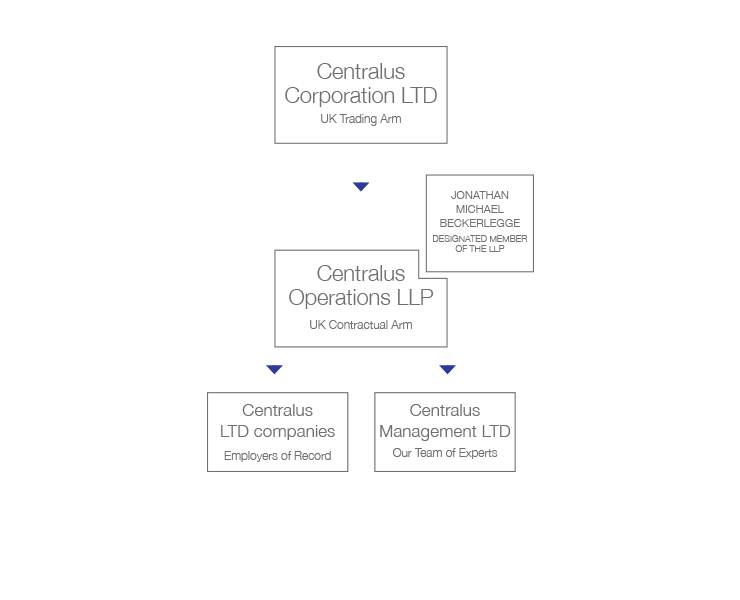
The Centralus Group companies are registered in England & Wales with numbers (Centralus Corporation LTD: 09560385, Centralus Operations LLP: OC407551,
Centralus LTD companies: see Companies House for full list, Centralus Management LTD: 10488654), and address Wynyard Park House, Wynyard Avenue, Wynyard TS22 5TB.
Centralus LTD companies: see Companies House for full list, Centralus Management LTD: 10488654), and address Wynyard Park House, Wynyard Avenue, Wynyard TS22 5TB.

Statement of Anti-Money Laundering (AML) and Counter-Terrorist Financing (CTF) policies and principles
Money Laundering and Terrorist Financing have been identified as major threats to the Centralus Group and, indeed, the international financial services community. The United Kingdom, in common with many other countries, has passed legislation designed to prevent money laundering and to combat terrorism.
Legal and regulatory framework
The principal requirements, obligations and penalties, on which Centralus financial crime systems and controls are based, are contained in:
• The proceeds of Crime Act 2002 (POCA), as amended by the:
i. Serious Organized Crime and Police Act 2005 (SOCPA); and the
ii. Proceeds of Crime Act (amendment) Regulations 2007;
·.The Terrorism Act 2000, as amended by the:
i. The Anti Terrorism, Crime & Security Act 2001; and the
ii. Terrorism Act (amendment) Regulations 2007;
• The Terrorism Act 2006;
• The Bribery Act 2010;
• The Money Laundering Regulations 2007, transposing the requirements of the E.U's third money laundering directive;
• The FCA handbook of rules and guidance, and in particular, the senior management arrangements, systems and controls (SFFISC) sourcebook, which relates to the management and control of money laundering risk; and
• The Joint Money Laundering Steering Group (JMLSG) guidance for the UK financial sector on the prevention of money laundering I combating terrorist financing.
Centralus policies & principles
Centralus is responsible for the following policies covering:
a. Anti-Money Laundering I Counter-Terrorist Financing I Counter-Proliferation Financing;
b. Training;
c. Anti-Bribery & Anti-Corruption ; and
d. Introducers.
These policies and principles are designed to ensure that all group companies comply with the legal and reg ulatory requirements applicable in the UK as well as with their local obligations.
Anti-Money Laundering (A.M.L) policy
Cer1tralus A.M.L policy is designed to ensure that comply with the requirements and obligations set out in UK legislation, regulations, rules and industry guidance for the fin ancial services sector, including the need to have adequate systems and controls in place to mitigate the risk of the firm being used to facilitate
fin ancial crime. The A.M.L policy sets out the minimum standards which must be complied with by all Centralus Group companies and includes:
• Establi shing and maintaining risk-based customer due diligence, identification, verification and know your customer (KFFIC) procedures, including enhanced due diligence for those customers presenting higher risk, such as politically exposed persons (peps) and correspondent banking relationships;
• Establishing and maintaining risk based systems and procedures to monitor ongoing customer activity;
• Procedures for reporting suspicious activity internally and to the relevant law enforcement authorities as appropriate;
• The maintenance of appropriate records for the minimum prescribed periods;
• Training and awareness for all relevant employees ; and
• The provision of appropriate management information and reporting to senior management of the group's compliance with the requirements.
Training
All employees receive train ing on the Anti Money Laundering and Counter Terrorist Financing policies and principles at least once a year, with more detailed and advanced training for those whose roles involve major financial risks. Failure to comply with these policies and principles may give rise to disciplinary action, up to and including dismissal.
Anti-Bribery & Anti-Corruption policy
Centralus has a zero tolerance policy towards bribery and corruption. Centralus recognizes that bribery and corruption have an adverse effect on communities wherever they occur. If endemic, they can threaten laws, democratic processes and basic human freedoms, impoverishing states and distorting free trade and competition. Corruption is often associated with organized crime, money laundering and on occasions the financing of terrorism. In addition, the level and efficacy of investment and financing can be reduced, particularly within economically disadvantaged societies.
Centralus is committed to applying high standards of honesty and integrity consistently across our global operations and in all our business dealings. Fie are subject to the provisions of the UK bribery act 2010 and the U.S foreign corrupt practices act, which have extra-territorial effect globally, as well as applicable local anti-bribery laws in relevant jurisd ictions.
Introducers
In addition to the anti-bribery and anti-corruption policy, Centralus has an introducer clause described in the Introducer agreement. The clause covers the activities of all third parties that generate or retain business, or secure a business benefit, for Centralu s. These third parties are termed "introducers" by Centralus. Potential examples would include senior advisors, lead generators and existing clients of Centralus Group. Centralus introducer policy is designed to protect Centralus against the bribery and corruption risks, reputational risk, and wider operational and conduct risks associated with introducers. Centralus employees must apply the specific controls and procedures set out in the policy.
Centralus Group governance & conformance
Regular reviews of the effectiveness of these group policies are carried out in addition to audits periodically undertaken by Centralus internal audit function. This provides senior executive management oversight committees and the board audit committee with the necessary assurance regard ing the operating effectiveness of the group's controls relating to these policies .
Mr. Jonathan Beckerlegge

Money Laundering and Terrorist Financing have been identified as major threats to the Centralus Group and, indeed, the international financial services community. The United Kingdom, in common with many other countries, has passed legislation designed to prevent money laundering and to combat terrorism.
Legal and regulatory framework
The principal requirements, obligations and penalties, on which Centralus financial crime systems and controls are based, are contained in:
• The proceeds of Crime Act 2002 (POCA), as amended by the:
i. Serious Organized Crime and Police Act 2005 (SOCPA); and the
ii. Proceeds of Crime Act (amendment) Regulations 2007;
·.The Terrorism Act 2000, as amended by the:
i. The Anti Terrorism, Crime & Security Act 2001; and the
ii. Terrorism Act (amendment) Regulations 2007;
• The Terrorism Act 2006;
• The Bribery Act 2010;
• The Money Laundering Regulations 2007, transposing the requirements of the E.U's third money laundering directive;
• The FCA handbook of rules and guidance, and in particular, the senior management arrangements, systems and controls (SFFISC) sourcebook, which relates to the management and control of money laundering risk; and
• The Joint Money Laundering Steering Group (JMLSG) guidance for the UK financial sector on the prevention of money laundering I combating terrorist financing.
Centralus policies & principles
Centralus is responsible for the following policies covering:
a. Anti-Money Laundering I Counter-Terrorist Financing I Counter-Proliferation Financing;
b. Training;
c. Anti-Bribery & Anti-Corruption ; and
d. Introducers.
These policies and principles are designed to ensure that all group companies comply with the legal and reg ulatory requirements applicable in the UK as well as with their local obligations.
Anti-Money Laundering (A.M.L) policy
Cer1tralus A.M.L policy is designed to ensure that comply with the requirements and obligations set out in UK legislation, regulations, rules and industry guidance for the fin ancial services sector, including the need to have adequate systems and controls in place to mitigate the risk of the firm being used to facilitate
fin ancial crime. The A.M.L policy sets out the minimum standards which must be complied with by all Centralus Group companies and includes:
• Establi shing and maintaining risk-based customer due diligence, identification, verification and know your customer (KFFIC) procedures, including enhanced due diligence for those customers presenting higher risk, such as politically exposed persons (peps) and correspondent banking relationships;
• Establishing and maintaining risk based systems and procedures to monitor ongoing customer activity;
• Procedures for reporting suspicious activity internally and to the relevant law enforcement authorities as appropriate;
• The maintenance of appropriate records for the minimum prescribed periods;
• Training and awareness for all relevant employees ; and
• The provision of appropriate management information and reporting to senior management of the group's compliance with the requirements.
Training
All employees receive train ing on the Anti Money Laundering and Counter Terrorist Financing policies and principles at least once a year, with more detailed and advanced training for those whose roles involve major financial risks. Failure to comply with these policies and principles may give rise to disciplinary action, up to and including dismissal.
Anti-Bribery & Anti-Corruption policy
Centralus has a zero tolerance policy towards bribery and corruption. Centralus recognizes that bribery and corruption have an adverse effect on communities wherever they occur. If endemic, they can threaten laws, democratic processes and basic human freedoms, impoverishing states and distorting free trade and competition. Corruption is often associated with organized crime, money laundering and on occasions the financing of terrorism. In addition, the level and efficacy of investment and financing can be reduced, particularly within economically disadvantaged societies.
Centralus is committed to applying high standards of honesty and integrity consistently across our global operations and in all our business dealings. Fie are subject to the provisions of the UK bribery act 2010 and the U.S foreign corrupt practices act, which have extra-territorial effect globally, as well as applicable local anti-bribery laws in relevant jurisd ictions.
Introducers
In addition to the anti-bribery and anti-corruption policy, Centralus has an introducer clause described in the Introducer agreement. The clause covers the activities of all third parties that generate or retain business, or secure a business benefit, for Centralu s. These third parties are termed "introducers" by Centralus. Potential examples would include senior advisors, lead generators and existing clients of Centralus Group. Centralus introducer policy is designed to protect Centralus against the bribery and corruption risks, reputational risk, and wider operational and conduct risks associated with introducers. Centralus employees must apply the specific controls and procedures set out in the policy.
Centralus Group governance & conformance
Regular reviews of the effectiveness of these group policies are carried out in addition to audits periodically undertaken by Centralus internal audit function. This provides senior executive management oversight committees and the board audit committee with the necessary assurance regard ing the operating effectiveness of the group's controls relating to these policies .
Mr. Jonathan Beckerlegge
CENTRALUS is a fully committed member of its industry in minimising the impact of its activities on the environment.
The key points of its applied strategy in order to achieve this are:
1. Minimise waste by evaluating operations and ensuring they are as efficient as possible.
2. Minimise toxic emissions through the use of its materials and the source of its power requirements.
3. Actively promote and encourage recycling both internally, to its employees & officers, and amongst its customers and suppliers.
4. Source and promote a product range to minimise the environmental impact of both production and distribution.
5. Adopt a training programme for its personnel to raise awareness of environmental issues and enlist their support in improving the Company’s performance.
6. Meet and comply to the environmental legislation that relates to the Company.
7. Implement an accredited programme to offset the greenhouse gas emissions generated by our activities.
Where opportunities shall be identified, environmental initiatives may be extended to benefit the wider community; capturing the significance of social action and directly supporting the Company’s ethos and values.
This policy applies to all of the Company’s operations in the UK. This means that all employees, administrators, consultants, partners and businesses carried on by the Company and/or their subsidiaries, whether they are incorporated within the UK or not, must comply with it, with no exemptions.
Mr. Jonathan Beckerlegge
The key points of its applied strategy in order to achieve this are:
1. Minimise waste by evaluating operations and ensuring they are as efficient as possible.
2. Minimise toxic emissions through the use of its materials and the source of its power requirements.
3. Actively promote and encourage recycling both internally, to its employees & officers, and amongst its customers and suppliers.
4. Source and promote a product range to minimise the environmental impact of both production and distribution.
5. Adopt a training programme for its personnel to raise awareness of environmental issues and enlist their support in improving the Company’s performance.
6. Meet and comply to the environmental legislation that relates to the Company.
7. Implement an accredited programme to offset the greenhouse gas emissions generated by our activities.
Where opportunities shall be identified, environmental initiatives may be extended to benefit the wider community; capturing the significance of social action and directly supporting the Company’s ethos and values.
This policy applies to all of the Company’s operations in the UK. This means that all employees, administrators, consultants, partners and businesses carried on by the Company and/or their subsidiaries, whether they are incorporated within the UK or not, must comply with it, with no exemptions.
Mr. Jonathan Beckerlegge
This statement is made pursuant to section 54(1) of the Modern Slavery Act 2015 and constitutes our group’s slavery statement. This policy statement will be reviewed annually and published.
CENTRALUS has a zero tolerance approach to any form of modern slavery and human trafficking. We are committed to acting ethically, with integrity and transparency in all business dealings and to implementing effective systems and controls in place to safeguard against any form of modern slavery taking place within our business or our supply chain.
We are a very unique organisation that specialises in assisting companies in streamlining staff employment and payroll processing by incentivising staff through benefits and loyalty programmes whilst providing staff longevity and tax breaks.
To ensure a high level of understanding of the risks of modern slavery and human trafficking in our supply chains and our business, we provide training to relevant members of staff. All directors have been briefed on the subject. As part of our initiative to identify and mitigate risks we:
Continually audit & review our practices;
Encourage the reporting of concerns and the protection of whistle blowers;
Not knowingly, as a Company, support or deal with any business involved in slavery or human trafficking; and
Have zero tolerance to slavery and human trafficking.
We expect all those in our supply chain to fully comply with our values. We use the following key performance indicators to measure how effective we have been to ensure that slavery and human trafficking is not taking place in any part of our business or supply chains:
Completion of in-house audits & staff training levels;
Level of communication and personal contact with next link in the supply chain and their understanding of, and compliance with, our expectations; and
Investigations undertaken into reports of modern slavery and remedial actions taken in response.
The company directors and senior management shall have the responsibility to implement this policy statement and its objectives and shall provide adequate resources and investments to ensure that slavery and human trafficking does not take place within the organisation or within its supply chains.
Mr. Jonathan Beckerlegge
CENTRALUS has a zero tolerance approach to any form of modern slavery and human trafficking. We are committed to acting ethically, with integrity and transparency in all business dealings and to implementing effective systems and controls in place to safeguard against any form of modern slavery taking place within our business or our supply chain.
We are a very unique organisation that specialises in assisting companies in streamlining staff employment and payroll processing by incentivising staff through benefits and loyalty programmes whilst providing staff longevity and tax breaks.
To ensure a high level of understanding of the risks of modern slavery and human trafficking in our supply chains and our business, we provide training to relevant members of staff. All directors have been briefed on the subject. As part of our initiative to identify and mitigate risks we:
Continually audit & review our practices;
Encourage the reporting of concerns and the protection of whistle blowers;
Not knowingly, as a Company, support or deal with any business involved in slavery or human trafficking; and
Have zero tolerance to slavery and human trafficking.
We expect all those in our supply chain to fully comply with our values. We use the following key performance indicators to measure how effective we have been to ensure that slavery and human trafficking is not taking place in any part of our business or supply chains:
Completion of in-house audits & staff training levels;
Level of communication and personal contact with next link in the supply chain and their understanding of, and compliance with, our expectations; and
Investigations undertaken into reports of modern slavery and remedial actions taken in response.
The company directors and senior management shall have the responsibility to implement this policy statement and its objectives and shall provide adequate resources and investments to ensure that slavery and human trafficking does not take place within the organisation or within its supply chains.
Mr. Jonathan Beckerlegge
Mission Statement
In Centralus we believe that our success is established, based on the professional and ethical behaviour of our people. Consequently, our reputation, both as individuals and as a firm, depends on it. As HR & Payroll professionals, we are responsible for adding value to the organisations we serve and contribute to their ethical success. We take on the responsibility for our individual decisions and actions. We are also advocates for the profession by engaging in activities that enhance its credibility and value.
Our clients place their trust in us and in the work that we do. So, for us, it is paramount that we follow the highest ethical standards by providing services of the highest quality; thus, creating a business environment that reflects our fundamental beliefs including continuous development and innovation, responsibility, integrity and confidentiality.
Purpose of the Code
Centralus is committed to maintaining the highest standards of ethical and professional conduct and competency in HR and recruitment. All members are encouraged to be advocates of promoting best practice within the profession and must comply with the standards set out in this Code of Conduct.
Our Code of Conduct highlights those key characteristics, which create an environment reflecting the highest professional and ethical standards.
Commitments
To support the organisations we work with in achieving their objectives and goals.
To inform and educate current and future professionals, the organisations we serve, and the general public about the 7 principles and practices that help the profession (selflessness, integrity, objectivity, accountability, openness, honesty & leadership).
To build respect, credibility and strategic importance within our organisation, the business community and the communities in which we work.
To positively influence workplace and recruitment practices.
To encourage professional decision-making and responsibility.
To encourage social responsibility.
To comply with the law.
Actions
Adhere to the highest standards of ethical and professional behaviour.
Measure the effectiveness of HR in contributing to or achieving organisational goals.
Our work is consistent with the values of the profession.
Strive to achieve the highest levels of service, performance and social responsibility.
Advocate for the appropriate use and appreciation of human beings as employees.
Advocate openly and within the established forums for debate in order to influence decision-making and results.
Professional Development
As professionals, we must seek to continually develop our professional knowledge and competence.
Commitments
To expand our knowledge in human resource management to further our understanding of how our organisation functions.
To advance our understanding of how organisations work (“the business of the business”).
To learn from appraisals and performance reviews and undertake further education and training, if necessary.
Actions
Pursue formal academic opportunities.
Commit to continuous learning, skills development and application of new knowledge related to both human resource management and the organisations we serve.
Contribute towards acquiring knowledge, the evolution of the profession and the development of individuals through learning, research and the dissemination of knowledge.
Pursue certification, where available, or comparable measures of competencies and knowledge.
Ethical Leadership
In Centralus, we believe in the need to exhibit individual leadership as a role model for maintaining the highest standards of ethical conduct.
Commitments
To set the standards and be a role model for others.
To earn individual respect and increase our credibility with those we serve.
Actions
Be ethical; act ethically in every professional interaction.
Question pending individual and group actions, when necessary, to ensure that decisions made are ethical and are implemented in an ethical manner.
Seek expert guidance, if ever in doubt, about the ethical propriety of a situation.
Through teaching and mentoring, champion the development of others as ethical leaders in the profession and in organisations.
Fairness and Justice
As human resource professionals, we are ethically responsible for promoting and fostering fairness and justice for all employees and their organisations.
Commitments
To respect diversity and not discriminate against people.
To create and sustain an environment that encourages all individuals, and the organisation itself, to reach their fullest potential in a positive and productive manner.
Actions
Treat people with dignity, respect and compassion to foster a trusting work environment free of harassment, intimidation and unlawful discrimination.
Ensure that everyone has the opportunity to develop skills and new competencies.
Provide an environment of inclusiveness and ensure commitment to diversity in the organisations we serve.
Develop, administer and advocate policies and procedures that foster fair, consistent and equitable treatment for all.
Regardless of personal interests, support decisions made by our organisation that are both ethical and legal.
Act in a responsible manner and practice sound management in the country (-ies) in which the organisations we serve operate.
Conflicts of Interest
As HR professionals, we must maintain a high level of trust with our stakeholders. We must protect the interests of our stakeholders as well as our professional integrity and should not engage in activities that create actual, apparent or potential conflicts of interest.
Commitments
To avoid activities that are in conflict, or may appear to be in conflict, with any of the provisions of this Code of Ethical and Professional Standards in Human Resource Management or with one’s responsibilities and duties as a member of the human resource profession and/or as an employee of any organisation.
Actions
Adhere to and encourage the use of published policies on conflicts of interest within your organisation.
Refrain from using your position for personal, material or financial gain or the appearance of such.
Refrain from giving or seeking preferential treatment in human processes.
Prioritise obligations to identify conflicts of interest or the appearance thereof; when conflicts arise, disclose them to relevant stakeholders.
Use of Information
We take into account and protect the rights of individuals, especially in the acquisition and distribution of information while safeguarding truthful communications and enabling informed decision-making.
Commitments
To build trust among all the parts of the organisation by maximising the open exchange of information and, in parallel, eliminating anxieties about inappropriate and/or inaccurate attainment and sharing of information.
Respect the confidentiality of both clients and candidates and comply with the relevant laws.
Actions
Acquire and circulate information through ethical and responsible means.
Ensure only appropriate information is used in decisions affecting the employment relationship.
Investigate the accuracy and source of information before allowing it to be used in employment-related decisions.
Maintain up-to-date and accurate HR information.
Safeguard restricted or confidential information.
Take appropriate steps to ensure the accuracy and completeness of all communicated information about HR policies and practices.
Take appropriate steps to ensure the accuracy and completeness of all communicated information used in HR-related training.
Mr. Jonathan Beckerlegge
In Centralus we believe that our success is established, based on the professional and ethical behaviour of our people. Consequently, our reputation, both as individuals and as a firm, depends on it. As HR & Payroll professionals, we are responsible for adding value to the organisations we serve and contribute to their ethical success. We take on the responsibility for our individual decisions and actions. We are also advocates for the profession by engaging in activities that enhance its credibility and value.
Our clients place their trust in us and in the work that we do. So, for us, it is paramount that we follow the highest ethical standards by providing services of the highest quality; thus, creating a business environment that reflects our fundamental beliefs including continuous development and innovation, responsibility, integrity and confidentiality.
Purpose of the Code
Centralus is committed to maintaining the highest standards of ethical and professional conduct and competency in HR and recruitment. All members are encouraged to be advocates of promoting best practice within the profession and must comply with the standards set out in this Code of Conduct.
Our Code of Conduct highlights those key characteristics, which create an environment reflecting the highest professional and ethical standards.
Commitments
To support the organisations we work with in achieving their objectives and goals.
To inform and educate current and future professionals, the organisations we serve, and the general public about the 7 principles and practices that help the profession (selflessness, integrity, objectivity, accountability, openness, honesty & leadership).
To build respect, credibility and strategic importance within our organisation, the business community and the communities in which we work.
To positively influence workplace and recruitment practices.
To encourage professional decision-making and responsibility.
To encourage social responsibility.
To comply with the law.
Actions
Adhere to the highest standards of ethical and professional behaviour.
Measure the effectiveness of HR in contributing to or achieving organisational goals.
Our work is consistent with the values of the profession.
Strive to achieve the highest levels of service, performance and social responsibility.
Advocate for the appropriate use and appreciation of human beings as employees.
Advocate openly and within the established forums for debate in order to influence decision-making and results.
Professional Development
As professionals, we must seek to continually develop our professional knowledge and competence.
Commitments
To expand our knowledge in human resource management to further our understanding of how our organisation functions.
To advance our understanding of how organisations work (“the business of the business”).
To learn from appraisals and performance reviews and undertake further education and training, if necessary.
Actions
Pursue formal academic opportunities.
Commit to continuous learning, skills development and application of new knowledge related to both human resource management and the organisations we serve.
Contribute towards acquiring knowledge, the evolution of the profession and the development of individuals through learning, research and the dissemination of knowledge.
Pursue certification, where available, or comparable measures of competencies and knowledge.
Ethical Leadership
In Centralus, we believe in the need to exhibit individual leadership as a role model for maintaining the highest standards of ethical conduct.
Commitments
To set the standards and be a role model for others.
To earn individual respect and increase our credibility with those we serve.
Actions
Be ethical; act ethically in every professional interaction.
Question pending individual and group actions, when necessary, to ensure that decisions made are ethical and are implemented in an ethical manner.
Seek expert guidance, if ever in doubt, about the ethical propriety of a situation.
Through teaching and mentoring, champion the development of others as ethical leaders in the profession and in organisations.
Fairness and Justice
As human resource professionals, we are ethically responsible for promoting and fostering fairness and justice for all employees and their organisations.
Commitments
To respect diversity and not discriminate against people.
To create and sustain an environment that encourages all individuals, and the organisation itself, to reach their fullest potential in a positive and productive manner.
Actions
Treat people with dignity, respect and compassion to foster a trusting work environment free of harassment, intimidation and unlawful discrimination.
Ensure that everyone has the opportunity to develop skills and new competencies.
Provide an environment of inclusiveness and ensure commitment to diversity in the organisations we serve.
Develop, administer and advocate policies and procedures that foster fair, consistent and equitable treatment for all.
Regardless of personal interests, support decisions made by our organisation that are both ethical and legal.
Act in a responsible manner and practice sound management in the country (-ies) in which the organisations we serve operate.
Conflicts of Interest
As HR professionals, we must maintain a high level of trust with our stakeholders. We must protect the interests of our stakeholders as well as our professional integrity and should not engage in activities that create actual, apparent or potential conflicts of interest.
Commitments
To avoid activities that are in conflict, or may appear to be in conflict, with any of the provisions of this Code of Ethical and Professional Standards in Human Resource Management or with one’s responsibilities and duties as a member of the human resource profession and/or as an employee of any organisation.
Actions
Adhere to and encourage the use of published policies on conflicts of interest within your organisation.
Refrain from using your position for personal, material or financial gain or the appearance of such.
Refrain from giving or seeking preferential treatment in human processes.
Prioritise obligations to identify conflicts of interest or the appearance thereof; when conflicts arise, disclose them to relevant stakeholders.
Use of Information
We take into account and protect the rights of individuals, especially in the acquisition and distribution of information while safeguarding truthful communications and enabling informed decision-making.
Commitments
To build trust among all the parts of the organisation by maximising the open exchange of information and, in parallel, eliminating anxieties about inappropriate and/or inaccurate attainment and sharing of information.
Respect the confidentiality of both clients and candidates and comply with the relevant laws.
Actions
Acquire and circulate information through ethical and responsible means.
Ensure only appropriate information is used in decisions affecting the employment relationship.
Investigate the accuracy and source of information before allowing it to be used in employment-related decisions.
Maintain up-to-date and accurate HR information.
Safeguard restricted or confidential information.
Take appropriate steps to ensure the accuracy and completeness of all communicated information about HR policies and practices.
Take appropriate steps to ensure the accuracy and completeness of all communicated information used in HR-related training.
Mr. Jonathan Beckerlegge
1.Introduction
Background to the General Data Protection Regulation (‘GDPR’)
The General Data Protection Regulation 2016 replaces the EU Data Protection Directive of 1995 and supersedes the laws of individual Member States that were developed in compliance with the Data Protection Directive 95/46/EC. Its purpose is to protect the “rights and freedoms” of natural persons (i.e. living individuals) and to ensure that personal data is not processed without their knowledge, and, wherever possible, that it is processed with their consent.
UK currently relies on the Data Protection Act 1998 that complies with the aforementioned 1995 EU Directive. It defines the law of processing data on identifiable living people and most of it does not apply to domestic use. Anyone holding personal data for other purposes is legally liable to comply with this Act, with a few notable exceptions.
1.2 Definitions
Personal data – any information relating to an identified or identifiable natural person (‘data subject’); an identifiable natural person is one who can be identified, directly or indirectly, in particular by reference to an identifier such as a name, an identification number, location data, an online identifier or to one or more factors specific to the physical, physiological, genetic, mental, economic, cultural or social identity of that natural person.
Data controller – the natural or legal person, public authority, agency or other body which, alone or jointly with others, determines the purposes and means of the processing of personal data; where the purposes and means of such processing are determined by Union or Member State law, the controller or the specific criteria for its nomination may be provided for by Union or Member State law.
Individual or Data subject – any living individual who is the subject of personal data held by an organisation.
Processing – any operation or set of operations which is performed on personal data or on sets of personal data, whether or not by automated means, such as collection, recording, organisation, structuring, storage, adaptation or alteration, retrieval, consultation, use, disclosure by transmission, dissemination or otherwise making available, alignment or combination, restriction, erasure or destruction.
Personal data breach – a breach of security leading to the accidental, or unlawful, destruction, loss, alteration, unauthorised disclosure of, or access to, personal data transmitted, stored or otherwise processed. There is an obligation on the controller to report personal data breaches to the supervisory authority and where the breach is likely to adversely affect the personal data or privacy of the data subject.
Consent – means any freely given, specific, informed and unambiguous indication of the data subject’s wishes by which he or she, by a statement or by a clear affirmative action, signifies agreement to the processing of personal data.
Child – the GDPR defines a child as anyone under the age of 16 years old, although this may be lowered to 13 by Member State law. The processing of personal data of a child is only lawful if parental or custodian consent has been obtained. The controller shall make reasonable efforts to verify in such cases that consent is given or authorised by the holder of parental responsibility over the child.
Third party – a natural or legal person, public authority, agency or body other than the data subject, controller, processor and persons who, under the direct authority of the controller or processor, are authorised to process personal data.
Filing system – any structured set of personal data which are accessible according to specific criteria, whether centralised, decentralised or dispersed on a functional or geographical basis.
Data Protection Policy statement
2.1 Centralus, with registered address at Wynyard Park House, Wynyard Avenue, Wynyard, TS22 5TB and various offices across the United Kingdom is committed to compliance with all relevant EU and Member State laws in respect of personal data, and the protection of the “rights and freedoms” of individuals whose information Centralus collects and processes in accordance with the GDPR.
2.2 Compliance with the GDPR is described by this policy and other relevant policies such as the Information Security Policy (ISP) along with connected processes and procedures.
2.3 The GDPR and this policy shall apply to all of Centralus’s data processing functions, including those performed on customers’, clients’, employees’, suppliers’, and partners’ personal data, and any other personal data the organisation processes from any source.
2.4 Centralus has established objectives for data protection and privacy, which are in the Personal Information Management System (PIMS).
2.5 The Data Protection Officer (DPO) shall be responsible for reviewing the register of data processing annually in the light of any changes to Centralus’s activities and to any additional requirements identified by means of Data Protection Impact Assessment (DPIA).
2.6 This policy applies to all Employees/Staff/Contractors/Clients/Partners and third party providers of Centralus. Any breach of the GDPR will be dealt with under Centralus’ Breach Notification Procedure and/or Incident Management Centre (IMC) and may also be a criminal offence, in which case the matter will be reported as soon as possible to the appropriate authorities.
2.7 Partners and any third parties working with or for Centralus, and who have or may have access to personal data, will be expected to have read, understood and to comply with this policy. No third party may access personal data held by Centralus without having first entered into a Data Confidentiality Agreement, which imposes on the third-party obligations no less onerous than those to which Centralus is committed, and which gives Centralus the right to audit compliance with the agreement.
Personal Information Management System & Information Security Policy (PIMS/ISP)
To support compliance with the GDPR, Centralus Board has approved and supported the development, implementation, maintenance and continual improvement of a documented PIMS, which is integrated within the ISP, for Centralus.
All Employees/Staff of Centralus and third party providers identified in the inventory are expected to comply with this policy and with the PIMS/ISP that implements this policy. All Employees/Staff will receive appropriate training.
Scope
The scope of the PIMS will cover all of the PII (Personally Identifiable Information) that the organisation holds including PII that is shared with external organisations such as suppliers, cloud providers, etc.
In determining its scope for compliance with the GDPR, Centralus considers:
any external and internal issues that are relevant to the purpose of Centralus and that affect its ability to achieve the intended outcomes of its PIMS/ISP;
specific needs and expectations of interested parties that are relevant to the implementation of the PIMS/ISP;
organizational objectives and obligations;
the organisation’s acceptable level of risk; and
any applicable statutory, regulatory, or contractual obligations.
The PIMS is documented within the ISP system, maintained in the Centralus Intranet. Centralus’s objectives for compliance with the GDPR are consistent with this policy, measurable, take into account GDPR privacy requirements and the results from risk assessments and risk treatments, monitored, communicated and updated as appropriate.
Responsibilities and roles under the General Data Protection Regulation
4.1 Centralus is a data controller for staff and marketing data and a data processor for client data under the GDPR.
4.2 The DPO and all those in managerial or supervisory roles throughout Centralus are responsible for developing and encouraging good information handling practices within Centralus.
4.3 The DPO’s role is specified in the GDPR. The DPO is accountable to Board of Directors of Centralus for the management of personal data within Centralus and for ensuring that compliance with data protection legislation and good practice can be demonstrated. This accountability includes development and implementation of the GDPR as required by this policy, and security and risk management in relation to compliance with the policy.
4.4 The DPO has been appointed to take responsibility for Centralus ‘s compliance with this policy on a day-to-day basis and has direct responsibility for ensuring that Centralus complies with the GDPR.
4.5 The DPO shall have specific responsibilities in respect of procedures such as the Subject Access Request Procedure and is the first point of call for Employees/Staff seeking clarification on any aspect of data protection compliance.
4.6 Compliance with data protection legislation is the responsibility of all Employees/Staff of Centralus who process personal data.
4.7 Centralus’s Training Policy sets out specific GDPR training and awareness requirements in relation to specific roles and Employees/Staff of Centralus generally.
4.8 Employees/Staff of Centralus are responsible for ensuring that any personal data about them and supplied by them to Centralus is accurate and up-to-date.
Data Protection principles
All processing of personal data must be conducted in accordance with the data protection principles as set out in Article 5 of the GDPR. Centralus’s policies and procedures are designed to ensure compliance with the principles.
Personal data must be processed lawfully, fairly and transparently
Lawfully – you must identify a lawful basis before you can process personal data. These are often referred to as the “conditions for processing”, for example, consent.
Fairly – in order for processing to be fair, the data controller has to make certain information available to the data subjects as practicable. This applies whether the personal data was obtained directly from the data subjects or from other sources.
Transparently – the GDPR includes rules on giving privacy information to data subjects in Articles 12, 13 and 14. These are detailed and specific, placing an emphasis on making privacy notices understandable and accessible. Information must be communicated to the data subject in an intelligible form using clear and plain language.
The specific information that must be provided to the data subject must, as a minimum, include:
the identity and the contact details of the controller and, if any, of the controller’s representative;
the contact details of the DPO;
the purposes of the processing for which the personal data are intended as well as the legal basis for the processing;
the period for which the personal data will be stored;
the existence of the rights to request access, rectification, erasure or to object to the processing, and the conditions (or lack of) relating to exercising these rights, such as whether the lawfulness of previous processing will be affected;
the categories of personal data concerned;
any further information necessary to guarantee fair processing.
Personal data can only be collected for specific, explicit and legitimate purposes
Data obtained for specified purposes must not be used for a purpose that differs from those formally notified to the supervisory authority as part of Centralus’s GDPR register of processing. The Privacy Procedure sets out the relevant procedures.
Personal data must be adequate, relevant and limited to what is necessary for processing
The DPO is responsible for ensuring that Centralus does not collect information that is not strictly necessary for the purpose for which it is obtained.
All data collection forms (electronic or paper-based), including data collection requirements in new information systems, must include a fair processing statement or a link to privacy statement and approved by the DPO.
The DPO will ensure that, on an annual basis all data collection methods are reviewed by internal audit to ensure that collected data continues to be adequate, relevant and not excessive.
Personal data must be accurate and kept up to date with every effort to erase or rectify without delay
Data that is stored by the data controller must be reviewed and updated as necessary. No data should be kept unless it is reasonable to assume that it is accurate. The DPO is responsible for ensuring that all staff are trained in the importance of collecting accurate data and maintaining it.
Employees/Staff/clients/contractors and third-party providers should be required to notify Centralus of any changes in circumstance to enable personal records to be updated accordingly. It is the responsibility of Centralus to ensure that any notification regarding change of circumstances is recorded and acted upon.
The DPO is responsible for ensuring that appropriate procedures and policies are in place to keep personal data accurate and up to date, taking into account the volume of data collected, the speed with which it might change and any other relevant factors.
On at least an annual basis, the DPO will review the retention dates of all the personal data processed by Centralus, by reference to the data inventory, and will identify any data that is no longer required in the context of the registered purpose. This data will be securely deleted/destroyed in line with the Information Disposal Policy.
The DPO is responsible for responding to requests for rectification from data subjects within one month. This can be extended to a further two months for complex requests. If Centralus decides not to comply with the request, the DPO must respond to the data subject to explain its reasoning and inform them of their right to complain to the supervisory authority and seek judicial remedy.
Personal data must be kept in a form such that the data subject can be identified only as long as is necessary for processing.
Where personal data is retained beyond the processing date, it will be minimised/encrypted/pseudonymised in order to protect the identity of the data subject in the event of a data breach. Personal data will be retained in line with the ISP and, once its retention date is passed, it must be securely destroyed as set out in this procedure.
The DPO must specifically approve any data retention that exceeds the retention periods defined in the ISP and must ensure that the justification is clearly identified and in line with the requirements of the data protection legislation. This approval must be written.
Personal data must be processed in a manner that ensures the appropriate security
The DPO will carry out a Data Protection Risk Assessment (DPIA) taking into account all the circumstances of Centralus’ controlling or processing operations.
In determining appropriateness, the DPO should also consider the extent of possible damage or loss that might be caused to individuals (e.g. staff or customers) if a security breach occurs, the effect of any security breach on Centralus itself, and any likely reputational damage including the possible loss of customer trust.
When assessing appropriate technical measures, the DPO shall consider the following:
Password Protection
Automatic locking of idle terminals;
Removal of access rights for USB and other memory media;
Virus checking software and firewalls;
Role-based access rights including those assigned to temporary staff;
Encryption of devices that leave the organisations premises such as laptops;
Security of local and wide area networks;
Privacy enhancing technologies such as pseudonymisation and anonymisation;
Identifying appropriate international security standards relevant to Centralus.
When assessing appropriate organisational measures, the DPO shall consider the following:
The appropriate training levels throughout Centralus;
Measures that consider the reliability of employees (such as references etc.);
The inclusion of data protection clause in employment contracts;
Identification of disciplinary action measures for data breaches;
Monitoring of staff for compliance with relevant security standards;
Physical access controls to electronic and paper-based records;
Adoption of a clear desk policy;
Storing of paper-based data in lockable fire-proof cabinets;
Restricting the use of portable electronic devices outside of the workplace;
Restricting the use of employees’ own personal devices being used in the workplace;
Adopting clear rules about passwords;
Making regular backups of personal data and storing the media off-site.
These controls have been selected on the basis of identified risks to personal data, and the potential for damage or distress to individuals whose data is being processed. Centralus’s compliance with this principle is contained in its PIMS, which has been developed in line with the ISP.
The controller must be able to demonstrate compliance with the GDPR’s other principles (accountability)
The GDPR includes provisions that promote accountability and governance. These complement the GDPR’s transparency requirements. The accountability principle in Article 5(2) requires you to demonstrate that you comply with the principles and states explicitly that this is your responsibility.
Centralus will demonstrate compliance with the data protection principles by implementing data protection policies, adhering to codes of conduct, implementing technical and organisational measures, as well as adopting techniques such as data protection by design, DPIAs, breach notification procedures and incident response plans.
Personal Data individuals’ rights
Each individual shall have the following rights regarding data processing, and the data that is recorded about them:
To make access requests regarding the nature of information held and to whom it has been disclosed.
To prevent processing likely to cause damage or distress.
To prevent processing for purposes of direct marketing.
To be informed about the mechanics of automated decision-taking process that will significantly affect them.
To not have significant decisions that will affect them taken solely by automated process.
To sue for compensation if they suffer damage by any contravention of the GDPR.
To take action to rectify, block, erase or destroy inaccurate data.
To request the supervisory authority to assess whether any provision of the GDPR has been contravened.
To have personal data provided to them in a structured, commonly used and machine-readable format, and the right to have that data transmitted to another controller.
To object to any automated profiling that is occurring without consent.
Centralus ensures that individuals may exercise these rights by making data access requests as described in the Acceptable Use Agreement, which shall include the Subject Access Request Procedure. This procedure also describes how Centralus will ensure that its response to the data access request complies with the requirements of the GDPR.
Individuals shall also have the right to complain to Centralus related to the processing of their personal data, handling of a request from a data subject and appeals from a data subject on how complaints have been handled in line with the Complaints Procedure.
Consent
7.1 Centralus understands “consent” to mean that it has been explicitly and freely given, and a specific, informed and unambiguous indication of the data subject’s wishes that, by statement or by a clear affirmative action, signifies agreement to the processing of personal data relating to him or her. The data subject can withdraw their consent at any time.
7.2 Centralus understands “consent” to mean that the data subject has been fully informed of the intended processing and has signified their agreement, while in a fit state of mind to do so and without pressure being exerted upon them. Consent obtained under duress or on the basis of misleading information will not be a valid basis for processing.
7.3 There must be some active communication between the parties to demonstrate active consent. Consent cannot be inferred from non-response to a communication. The Controller must be able to demonstrate that consent was obtained for the processing operation.
7.4 For sensitive data, explicit written consent of individuals must be obtained unless an alternative legitimate basis for processing exists.
7.5 In most instances, consent to process personal and sensitive data is obtained routinely by Centralus using standard consent documents e.g. when a new client signs a contract, or during induction for participants on programmes.
7.6 Where Centralus provides online services to children, parental or custodial authorisation must be obtained. This requirement applies to children under the age of 16. Centralus does not routinely process data in this category.
Security of Data
8.1 All Employees/Staff are responsible for ensuring that any personal data that Centralus holds and for which they are responsible, is kept securely and is not under any conditions disclosed to any third party unless that third party has been specifically authorised by Centralus to receive that information and has entered into a confidentiality agreement.
8.2 All personal data should be accessible only to those who need to use it, and access may only be granted in line with the Access Control Policy.
8.3 Care must be taken to ensure that PC screens and terminals are not visible except to authorised Employees/Staff of Centralus. All Employees/Staff are required to enter into an Acceptable Use Agreement before they are given access to organisational information of any sort, which details rules on screen time-outs.
8.4 Manual records may not be left where they can be accessed by unauthorised personnel and may not be removed from business premises without explicit written authorisation. As soon as manual records are no longer required for day-to-day client support, they must be removed from secure archiving in line with the Information Disposal Policy.
8.5 Personal data may only be deleted or disposed of in line with the Information Retention procedure. Manual records that have reached their retention date are to be shredded and disposed of as “confidential waste”. Hard drives of redundant PCs are to be removed and immediately destroyed as required by the Information Disposal Policy.
Disclosure of Data
Centralus must ensure that personal data is not disclosed to unauthorised third parties which includes family members, friends, government bodies, and in certain circumstances, the Police. All Employees/Staff should exercise caution when asked to disclose personal data held on another individual to a third party. It is important to bear in mind whether or not disclosure of the information is relevant to, and necessary for the conduct of Centralus’s business.
Retention and Disposal of Data
10.1 Centralus shall not keep personal data in a form that permits identification of data subjects for longer a period than Centralus is necessary, in relation to the purpose(s) for which the data was originally collected.
10.2 Centralus may store data for longer periods if the personal data will be processed solely for archiving purposes in the public interest, scientific or historical research purposes or statistical purposes, subject to the implementation of appropriate technical and organisational measures to safeguard the rights and freedoms of the data subject.
10.3 The retention period for each category of personal data will be set out in the Information Retention procedure along with the criteria used to determine this period including any statutory obligations Centralus has to retain the data.
10.4 Centralus’s information retention and information disposal procedures apply in all cases.
10.5 Personal data must be disposed of securely in accordance with the sixth principle of the GDPR. Any disposal of data will be done in accordance with the secure disposal procedure.
Data Transfers
All exports of data from within the European Economic Area (EEA) to non-European Economic Area countries (referred to in the GDPR as “third countries”) are unlawful unless there is an appropriate “level of protection for the fundamental rights of the data subjects”.
The broader area of the EEA is granted “adequacy” on the basis that all such countries are signatories to the GDPR. The non-EU EEA member countries (Liechtenstein, Norway and Iceland) apply EU regulations through a Joint Committee Decision.
Binding corporate rules
Centralus may adopt approved binding corporate rules for the transfer of data outside the EU. This requires submission to the relevant supervisory authority for approval of the rules that Centralus is seeking to rely upon.
Model contract clauses
Centralus may adopt approved model contract clauses for the transfer of data outside of the EEA. If Centralus adopts the model contract clauses approved by the relevant supervisory authority there is an automatic recognition of adequacy.
Exceptions
In the absence of an adequacy decision, Privacy Shield membership, binding corporate rules and/or model contract clauses, a transfer of personal data to a third country or international organisation shall only take place on one of the following conditions:
the individual has explicitly consented to the proposed transfer, after having been informed of the possible risks of such transfers for the data subject due to the absence of an adequacy decision and appropriate safeguards;
the transfer is necessary for the performance of a contract between the individual and the controller or the implementation of pre-contractual measures taken at the data subject’s request;
the transfer is necessary for the conclusion or performance of a contract concluded in the interest of the data subject between the controller and another natural or legal person;
the transfer is necessary for important reasons of public interest;
the transfer is necessary for the establishment, exercise or defence of legal claims; and/or
the transfer is necessary in order to protect the vital interests of the data subject or of other persons, where the data subject is physically or legally incapable of giving consent.
Data Inventory
Centralus has established a Data Inventory and Data Flow process as part of its approach to address risks and opportunities throughout its GDPR compliance project. Centralus’s Data Inventory and Data Flow determines:
business processes that use personal data;
source of personal data;
volume of data subjects;
description of each item of personal data;
processing activity;
maintains the inventory of data categories of personal data processed;
documents the purpose(s) for which each category of personal data is used;
recipients, and potential recipients, of the personal data;
the role of the Centralus throughout the data flow;
key systems and repositories;
any data transfers; and
all retention and disposal requirements.
Centralus is aware of any risks associated with the processing of particular types of personal data:
Centralus assesses the level of risk to individuals associated with the processing of their personal data. Data Protection Impact Assessments (DPIAs) are carried out in relation to the processing of personal data by Centralus, and in relation to processing undertaken by other organisations on behalf of Centralus.
Centralus shall manage any risks identified by the risk assessment in order to reduce the likelihood of a non-conformance with this policy.
Where a type of processing, in particular using new technologies and taking into account the nature, scope, context and purposes of the processing is likely to result in a high risk to the rights and freedoms of natural persons, Centralus shall, prior to the processing, carry out a DPIA of the impact of the envisaged processing operations on the protection of personal data. A single DPIA may address a set of similar processing operations that present similar high risks.
Where, as a result of a DPIA it is clear that Centralus is about to commence processing of personal data that could cause damage Centralus and/or distress to the data subjects, the decision as to whether or not Centralus may proceed must be escalated for review to the DPO.
The DPO shall, if there are significant concerns, either as to the potential damage or distress, or the quantity of data concerned, escalate the matter to the supervisory authority.
Appropriate controls will be selected, as appropriate and applied to reduce the level of risk associated with processing individual data to an acceptable level, by reference to Centralus’s documented risk acceptance criteria and the requirements of the GDPR.
Background to the General Data Protection Regulation (‘GDPR’)
The General Data Protection Regulation 2016 replaces the EU Data Protection Directive of 1995 and supersedes the laws of individual Member States that were developed in compliance with the Data Protection Directive 95/46/EC. Its purpose is to protect the “rights and freedoms” of natural persons (i.e. living individuals) and to ensure that personal data is not processed without their knowledge, and, wherever possible, that it is processed with their consent.
UK currently relies on the Data Protection Act 1998 that complies with the aforementioned 1995 EU Directive. It defines the law of processing data on identifiable living people and most of it does not apply to domestic use. Anyone holding personal data for other purposes is legally liable to comply with this Act, with a few notable exceptions.
1.2 Definitions
Personal data – any information relating to an identified or identifiable natural person (‘data subject’); an identifiable natural person is one who can be identified, directly or indirectly, in particular by reference to an identifier such as a name, an identification number, location data, an online identifier or to one or more factors specific to the physical, physiological, genetic, mental, economic, cultural or social identity of that natural person.
Data controller – the natural or legal person, public authority, agency or other body which, alone or jointly with others, determines the purposes and means of the processing of personal data; where the purposes and means of such processing are determined by Union or Member State law, the controller or the specific criteria for its nomination may be provided for by Union or Member State law.
Individual or Data subject – any living individual who is the subject of personal data held by an organisation.
Processing – any operation or set of operations which is performed on personal data or on sets of personal data, whether or not by automated means, such as collection, recording, organisation, structuring, storage, adaptation or alteration, retrieval, consultation, use, disclosure by transmission, dissemination or otherwise making available, alignment or combination, restriction, erasure or destruction.
Personal data breach – a breach of security leading to the accidental, or unlawful, destruction, loss, alteration, unauthorised disclosure of, or access to, personal data transmitted, stored or otherwise processed. There is an obligation on the controller to report personal data breaches to the supervisory authority and where the breach is likely to adversely affect the personal data or privacy of the data subject.
Consent – means any freely given, specific, informed and unambiguous indication of the data subject’s wishes by which he or she, by a statement or by a clear affirmative action, signifies agreement to the processing of personal data.
Child – the GDPR defines a child as anyone under the age of 16 years old, although this may be lowered to 13 by Member State law. The processing of personal data of a child is only lawful if parental or custodian consent has been obtained. The controller shall make reasonable efforts to verify in such cases that consent is given or authorised by the holder of parental responsibility over the child.
Third party – a natural or legal person, public authority, agency or body other than the data subject, controller, processor and persons who, under the direct authority of the controller or processor, are authorised to process personal data.
Filing system – any structured set of personal data which are accessible according to specific criteria, whether centralised, decentralised or dispersed on a functional or geographical basis.
Data Protection Policy statement
2.1 Centralus, with registered address at Wynyard Park House, Wynyard Avenue, Wynyard, TS22 5TB and various offices across the United Kingdom is committed to compliance with all relevant EU and Member State laws in respect of personal data, and the protection of the “rights and freedoms” of individuals whose information Centralus collects and processes in accordance with the GDPR.
2.2 Compliance with the GDPR is described by this policy and other relevant policies such as the Information Security Policy (ISP) along with connected processes and procedures.
2.3 The GDPR and this policy shall apply to all of Centralus’s data processing functions, including those performed on customers’, clients’, employees’, suppliers’, and partners’ personal data, and any other personal data the organisation processes from any source.
2.4 Centralus has established objectives for data protection and privacy, which are in the Personal Information Management System (PIMS).
2.5 The Data Protection Officer (DPO) shall be responsible for reviewing the register of data processing annually in the light of any changes to Centralus’s activities and to any additional requirements identified by means of Data Protection Impact Assessment (DPIA).
2.6 This policy applies to all Employees/Staff/Contractors/Clients/Partners and third party providers of Centralus. Any breach of the GDPR will be dealt with under Centralus’ Breach Notification Procedure and/or Incident Management Centre (IMC) and may also be a criminal offence, in which case the matter will be reported as soon as possible to the appropriate authorities.
2.7 Partners and any third parties working with or for Centralus, and who have or may have access to personal data, will be expected to have read, understood and to comply with this policy. No third party may access personal data held by Centralus without having first entered into a Data Confidentiality Agreement, which imposes on the third-party obligations no less onerous than those to which Centralus is committed, and which gives Centralus the right to audit compliance with the agreement.
Personal Information Management System & Information Security Policy (PIMS/ISP)
To support compliance with the GDPR, Centralus Board has approved and supported the development, implementation, maintenance and continual improvement of a documented PIMS, which is integrated within the ISP, for Centralus.
All Employees/Staff of Centralus and third party providers identified in the inventory are expected to comply with this policy and with the PIMS/ISP that implements this policy. All Employees/Staff will receive appropriate training.
Scope
The scope of the PIMS will cover all of the PII (Personally Identifiable Information) that the organisation holds including PII that is shared with external organisations such as suppliers, cloud providers, etc.
In determining its scope for compliance with the GDPR, Centralus considers:
any external and internal issues that are relevant to the purpose of Centralus and that affect its ability to achieve the intended outcomes of its PIMS/ISP;
specific needs and expectations of interested parties that are relevant to the implementation of the PIMS/ISP;
organizational objectives and obligations;
the organisation’s acceptable level of risk; and
any applicable statutory, regulatory, or contractual obligations.
The PIMS is documented within the ISP system, maintained in the Centralus Intranet. Centralus’s objectives for compliance with the GDPR are consistent with this policy, measurable, take into account GDPR privacy requirements and the results from risk assessments and risk treatments, monitored, communicated and updated as appropriate.
Responsibilities and roles under the General Data Protection Regulation
4.1 Centralus is a data controller for staff and marketing data and a data processor for client data under the GDPR.
4.2 The DPO and all those in managerial or supervisory roles throughout Centralus are responsible for developing and encouraging good information handling practices within Centralus.
4.3 The DPO’s role is specified in the GDPR. The DPO is accountable to Board of Directors of Centralus for the management of personal data within Centralus and for ensuring that compliance with data protection legislation and good practice can be demonstrated. This accountability includes development and implementation of the GDPR as required by this policy, and security and risk management in relation to compliance with the policy.
4.4 The DPO has been appointed to take responsibility for Centralus ‘s compliance with this policy on a day-to-day basis and has direct responsibility for ensuring that Centralus complies with the GDPR.
4.5 The DPO shall have specific responsibilities in respect of procedures such as the Subject Access Request Procedure and is the first point of call for Employees/Staff seeking clarification on any aspect of data protection compliance.
4.6 Compliance with data protection legislation is the responsibility of all Employees/Staff of Centralus who process personal data.
4.7 Centralus’s Training Policy sets out specific GDPR training and awareness requirements in relation to specific roles and Employees/Staff of Centralus generally.
4.8 Employees/Staff of Centralus are responsible for ensuring that any personal data about them and supplied by them to Centralus is accurate and up-to-date.
Data Protection principles
All processing of personal data must be conducted in accordance with the data protection principles as set out in Article 5 of the GDPR. Centralus’s policies and procedures are designed to ensure compliance with the principles.
Personal data must be processed lawfully, fairly and transparently
Lawfully – you must identify a lawful basis before you can process personal data. These are often referred to as the “conditions for processing”, for example, consent.
Fairly – in order for processing to be fair, the data controller has to make certain information available to the data subjects as practicable. This applies whether the personal data was obtained directly from the data subjects or from other sources.
Transparently – the GDPR includes rules on giving privacy information to data subjects in Articles 12, 13 and 14. These are detailed and specific, placing an emphasis on making privacy notices understandable and accessible. Information must be communicated to the data subject in an intelligible form using clear and plain language.
The specific information that must be provided to the data subject must, as a minimum, include:
the identity and the contact details of the controller and, if any, of the controller’s representative;
the contact details of the DPO;
the purposes of the processing for which the personal data are intended as well as the legal basis for the processing;
the period for which the personal data will be stored;
the existence of the rights to request access, rectification, erasure or to object to the processing, and the conditions (or lack of) relating to exercising these rights, such as whether the lawfulness of previous processing will be affected;
the categories of personal data concerned;
any further information necessary to guarantee fair processing.
Personal data can only be collected for specific, explicit and legitimate purposes
Data obtained for specified purposes must not be used for a purpose that differs from those formally notified to the supervisory authority as part of Centralus’s GDPR register of processing. The Privacy Procedure sets out the relevant procedures.
Personal data must be adequate, relevant and limited to what is necessary for processing
The DPO is responsible for ensuring that Centralus does not collect information that is not strictly necessary for the purpose for which it is obtained.
All data collection forms (electronic or paper-based), including data collection requirements in new information systems, must include a fair processing statement or a link to privacy statement and approved by the DPO.
The DPO will ensure that, on an annual basis all data collection methods are reviewed by internal audit to ensure that collected data continues to be adequate, relevant and not excessive.
Personal data must be accurate and kept up to date with every effort to erase or rectify without delay
Data that is stored by the data controller must be reviewed and updated as necessary. No data should be kept unless it is reasonable to assume that it is accurate. The DPO is responsible for ensuring that all staff are trained in the importance of collecting accurate data and maintaining it.
Employees/Staff/clients/contractors and third-party providers should be required to notify Centralus of any changes in circumstance to enable personal records to be updated accordingly. It is the responsibility of Centralus to ensure that any notification regarding change of circumstances is recorded and acted upon.
The DPO is responsible for ensuring that appropriate procedures and policies are in place to keep personal data accurate and up to date, taking into account the volume of data collected, the speed with which it might change and any other relevant factors.
On at least an annual basis, the DPO will review the retention dates of all the personal data processed by Centralus, by reference to the data inventory, and will identify any data that is no longer required in the context of the registered purpose. This data will be securely deleted/destroyed in line with the Information Disposal Policy.
The DPO is responsible for responding to requests for rectification from data subjects within one month. This can be extended to a further two months for complex requests. If Centralus decides not to comply with the request, the DPO must respond to the data subject to explain its reasoning and inform them of their right to complain to the supervisory authority and seek judicial remedy.
Personal data must be kept in a form such that the data subject can be identified only as long as is necessary for processing.
Where personal data is retained beyond the processing date, it will be minimised/encrypted/pseudonymised in order to protect the identity of the data subject in the event of a data breach. Personal data will be retained in line with the ISP and, once its retention date is passed, it must be securely destroyed as set out in this procedure.
The DPO must specifically approve any data retention that exceeds the retention periods defined in the ISP and must ensure that the justification is clearly identified and in line with the requirements of the data protection legislation. This approval must be written.
Personal data must be processed in a manner that ensures the appropriate security
The DPO will carry out a Data Protection Risk Assessment (DPIA) taking into account all the circumstances of Centralus’ controlling or processing operations.
In determining appropriateness, the DPO should also consider the extent of possible damage or loss that might be caused to individuals (e.g. staff or customers) if a security breach occurs, the effect of any security breach on Centralus itself, and any likely reputational damage including the possible loss of customer trust.
When assessing appropriate technical measures, the DPO shall consider the following:
Password Protection
Automatic locking of idle terminals;
Removal of access rights for USB and other memory media;
Virus checking software and firewalls;
Role-based access rights including those assigned to temporary staff;
Encryption of devices that leave the organisations premises such as laptops;
Security of local and wide area networks;
Privacy enhancing technologies such as pseudonymisation and anonymisation;
Identifying appropriate international security standards relevant to Centralus.
When assessing appropriate organisational measures, the DPO shall consider the following:
The appropriate training levels throughout Centralus;
Measures that consider the reliability of employees (such as references etc.);
The inclusion of data protection clause in employment contracts;
Identification of disciplinary action measures for data breaches;
Monitoring of staff for compliance with relevant security standards;
Physical access controls to electronic and paper-based records;
Adoption of a clear desk policy;
Storing of paper-based data in lockable fire-proof cabinets;
Restricting the use of portable electronic devices outside of the workplace;
Restricting the use of employees’ own personal devices being used in the workplace;
Adopting clear rules about passwords;
Making regular backups of personal data and storing the media off-site.
These controls have been selected on the basis of identified risks to personal data, and the potential for damage or distress to individuals whose data is being processed. Centralus’s compliance with this principle is contained in its PIMS, which has been developed in line with the ISP.
The controller must be able to demonstrate compliance with the GDPR’s other principles (accountability)
The GDPR includes provisions that promote accountability and governance. These complement the GDPR’s transparency requirements. The accountability principle in Article 5(2) requires you to demonstrate that you comply with the principles and states explicitly that this is your responsibility.
Centralus will demonstrate compliance with the data protection principles by implementing data protection policies, adhering to codes of conduct, implementing technical and organisational measures, as well as adopting techniques such as data protection by design, DPIAs, breach notification procedures and incident response plans.
Personal Data individuals’ rights
Each individual shall have the following rights regarding data processing, and the data that is recorded about them:
To make access requests regarding the nature of information held and to whom it has been disclosed.
To prevent processing likely to cause damage or distress.
To prevent processing for purposes of direct marketing.
To be informed about the mechanics of automated decision-taking process that will significantly affect them.
To not have significant decisions that will affect them taken solely by automated process.
To sue for compensation if they suffer damage by any contravention of the GDPR.
To take action to rectify, block, erase or destroy inaccurate data.
To request the supervisory authority to assess whether any provision of the GDPR has been contravened.
To have personal data provided to them in a structured, commonly used and machine-readable format, and the right to have that data transmitted to another controller.
To object to any automated profiling that is occurring without consent.
Centralus ensures that individuals may exercise these rights by making data access requests as described in the Acceptable Use Agreement, which shall include the Subject Access Request Procedure. This procedure also describes how Centralus will ensure that its response to the data access request complies with the requirements of the GDPR.
Individuals shall also have the right to complain to Centralus related to the processing of their personal data, handling of a request from a data subject and appeals from a data subject on how complaints have been handled in line with the Complaints Procedure.
Consent
7.1 Centralus understands “consent” to mean that it has been explicitly and freely given, and a specific, informed and unambiguous indication of the data subject’s wishes that, by statement or by a clear affirmative action, signifies agreement to the processing of personal data relating to him or her. The data subject can withdraw their consent at any time.
7.2 Centralus understands “consent” to mean that the data subject has been fully informed of the intended processing and has signified their agreement, while in a fit state of mind to do so and without pressure being exerted upon them. Consent obtained under duress or on the basis of misleading information will not be a valid basis for processing.
7.3 There must be some active communication between the parties to demonstrate active consent. Consent cannot be inferred from non-response to a communication. The Controller must be able to demonstrate that consent was obtained for the processing operation.
7.4 For sensitive data, explicit written consent of individuals must be obtained unless an alternative legitimate basis for processing exists.
7.5 In most instances, consent to process personal and sensitive data is obtained routinely by Centralus using standard consent documents e.g. when a new client signs a contract, or during induction for participants on programmes.
7.6 Where Centralus provides online services to children, parental or custodial authorisation must be obtained. This requirement applies to children under the age of 16. Centralus does not routinely process data in this category.
Security of Data
8.1 All Employees/Staff are responsible for ensuring that any personal data that Centralus holds and for which they are responsible, is kept securely and is not under any conditions disclosed to any third party unless that third party has been specifically authorised by Centralus to receive that information and has entered into a confidentiality agreement.
8.2 All personal data should be accessible only to those who need to use it, and access may only be granted in line with the Access Control Policy.
8.3 Care must be taken to ensure that PC screens and terminals are not visible except to authorised Employees/Staff of Centralus. All Employees/Staff are required to enter into an Acceptable Use Agreement before they are given access to organisational information of any sort, which details rules on screen time-outs.
8.4 Manual records may not be left where they can be accessed by unauthorised personnel and may not be removed from business premises without explicit written authorisation. As soon as manual records are no longer required for day-to-day client support, they must be removed from secure archiving in line with the Information Disposal Policy.
8.5 Personal data may only be deleted or disposed of in line with the Information Retention procedure. Manual records that have reached their retention date are to be shredded and disposed of as “confidential waste”. Hard drives of redundant PCs are to be removed and immediately destroyed as required by the Information Disposal Policy.
Disclosure of Data
Centralus must ensure that personal data is not disclosed to unauthorised third parties which includes family members, friends, government bodies, and in certain circumstances, the Police. All Employees/Staff should exercise caution when asked to disclose personal data held on another individual to a third party. It is important to bear in mind whether or not disclosure of the information is relevant to, and necessary for the conduct of Centralus’s business.
Retention and Disposal of Data
10.1 Centralus shall not keep personal data in a form that permits identification of data subjects for longer a period than Centralus is necessary, in relation to the purpose(s) for which the data was originally collected.
10.2 Centralus may store data for longer periods if the personal data will be processed solely for archiving purposes in the public interest, scientific or historical research purposes or statistical purposes, subject to the implementation of appropriate technical and organisational measures to safeguard the rights and freedoms of the data subject.
10.3 The retention period for each category of personal data will be set out in the Information Retention procedure along with the criteria used to determine this period including any statutory obligations Centralus has to retain the data.
10.4 Centralus’s information retention and information disposal procedures apply in all cases.
10.5 Personal data must be disposed of securely in accordance with the sixth principle of the GDPR. Any disposal of data will be done in accordance with the secure disposal procedure.
Data Transfers
All exports of data from within the European Economic Area (EEA) to non-European Economic Area countries (referred to in the GDPR as “third countries”) are unlawful unless there is an appropriate “level of protection for the fundamental rights of the data subjects”.
The broader area of the EEA is granted “adequacy” on the basis that all such countries are signatories to the GDPR. The non-EU EEA member countries (Liechtenstein, Norway and Iceland) apply EU regulations through a Joint Committee Decision.
Binding corporate rules
Centralus may adopt approved binding corporate rules for the transfer of data outside the EU. This requires submission to the relevant supervisory authority for approval of the rules that Centralus is seeking to rely upon.
Model contract clauses
Centralus may adopt approved model contract clauses for the transfer of data outside of the EEA. If Centralus adopts the model contract clauses approved by the relevant supervisory authority there is an automatic recognition of adequacy.
Exceptions
In the absence of an adequacy decision, Privacy Shield membership, binding corporate rules and/or model contract clauses, a transfer of personal data to a third country or international organisation shall only take place on one of the following conditions:
the individual has explicitly consented to the proposed transfer, after having been informed of the possible risks of such transfers for the data subject due to the absence of an adequacy decision and appropriate safeguards;
the transfer is necessary for the performance of a contract between the individual and the controller or the implementation of pre-contractual measures taken at the data subject’s request;
the transfer is necessary for the conclusion or performance of a contract concluded in the interest of the data subject between the controller and another natural or legal person;
the transfer is necessary for important reasons of public interest;
the transfer is necessary for the establishment, exercise or defence of legal claims; and/or
the transfer is necessary in order to protect the vital interests of the data subject or of other persons, where the data subject is physically or legally incapable of giving consent.
Data Inventory
Centralus has established a Data Inventory and Data Flow process as part of its approach to address risks and opportunities throughout its GDPR compliance project. Centralus’s Data Inventory and Data Flow determines:
business processes that use personal data;
source of personal data;
volume of data subjects;
description of each item of personal data;
processing activity;
maintains the inventory of data categories of personal data processed;
documents the purpose(s) for which each category of personal data is used;
recipients, and potential recipients, of the personal data;
the role of the Centralus throughout the data flow;
key systems and repositories;
any data transfers; and
all retention and disposal requirements.
Centralus is aware of any risks associated with the processing of particular types of personal data:
Centralus assesses the level of risk to individuals associated with the processing of their personal data. Data Protection Impact Assessments (DPIAs) are carried out in relation to the processing of personal data by Centralus, and in relation to processing undertaken by other organisations on behalf of Centralus.
Centralus shall manage any risks identified by the risk assessment in order to reduce the likelihood of a non-conformance with this policy.
Where a type of processing, in particular using new technologies and taking into account the nature, scope, context and purposes of the processing is likely to result in a high risk to the rights and freedoms of natural persons, Centralus shall, prior to the processing, carry out a DPIA of the impact of the envisaged processing operations on the protection of personal data. A single DPIA may address a set of similar processing operations that present similar high risks.
Where, as a result of a DPIA it is clear that Centralus is about to commence processing of personal data that could cause damage Centralus and/or distress to the data subjects, the decision as to whether or not Centralus may proceed must be escalated for review to the DPO.
The DPO shall, if there are significant concerns, either as to the potential damage or distress, or the quantity of data concerned, escalate the matter to the supervisory authority.
Appropriate controls will be selected, as appropriate and applied to reduce the level of risk associated with processing individual data to an acceptable level, by reference to Centralus’s documented risk acceptance criteria and the requirements of the GDPR.



























































Mental Health: The Invisible Invasion on Your Workforce
The mental health of employees is, undoubtedly, one of the most challenging and unforeseen invasions on your business. In any business, there are certain people who seem to find it extremely difficult to cooperate with other colleagues. They tend to be absent-minded and unmotivated while their productivity deteriorates. They call in sick more often than before.
At least one in every six employees struggle with mental health problems, from mild to severe, such as:
Anger: The instinctive reaction to deception or frustration that can turn into a problem when it becomes unmanageable and starts having a negative impact on many aspects of a person’s life.
Depression: Potentially, a long-lasting situation, burdening everyday life and activities.
Anxiety and panic attacks: The overwhelming feeling of worrying constantly, even for no apparent reason, with unpleasant physical and psychological effects such as regular panic attacks.
Bipolar disorder: A mental situation that stumbles between manic and depressive episodes.
Phobia: An anxiety disorder characterised by an extreme fear of a situation, a place or a certain object, even when there is no danger.
Post-traumatic stress disorder: The distressing or disorienting feelings that follow a traumatic event.
Psychosis: The perception or interpretation of reality in an unorthodox way, usually including hallucinations and delusions.
Paranoia: A persistent feeling that there is a threat, filled with excessive suspicions and delusions of potential latent harm.
Unless treated accordingly and timely, the above situations can potentially reach a point where the person suffering is unable to cope with everyday activities and, inevitably, performs badly at work. He or she starts feeling helpless, caught up in a labyrinth of fear, guilt, low self-esteem and despair. What triggers this even more is the long-standing prejudice against mental health problems in the office. Lastly, if an employee takes time off on a difficult day, it is merely a band-aid rather than a cure.
As demonstrated in the Government Green Paper ‘Improving Lives’, mental health is the most significant source of disability in the UK.
At least one in every six employees struggle with mental health problems, from mild to severe, such as:
Anger: The instinctive reaction to deception or frustration that can turn into a problem when it becomes unmanageable and starts having a negative impact on many aspects of a person’s life.
Depression: Potentially, a long-lasting situation, burdening everyday life and activities.
Anxiety and panic attacks: The overwhelming feeling of worrying constantly, even for no apparent reason, with unpleasant physical and psychological effects such as regular panic attacks.
Bipolar disorder: A mental situation that stumbles between manic and depressive episodes.
Phobia: An anxiety disorder characterised by an extreme fear of a situation, a place or a certain object, even when there is no danger.
Post-traumatic stress disorder: The distressing or disorienting feelings that follow a traumatic event.
Psychosis: The perception or interpretation of reality in an unorthodox way, usually including hallucinations and delusions.
Paranoia: A persistent feeling that there is a threat, filled with excessive suspicions and delusions of potential latent harm.
Unless treated accordingly and timely, the above situations can potentially reach a point where the person suffering is unable to cope with everyday activities and, inevitably, performs badly at work. He or she starts feeling helpless, caught up in a labyrinth of fear, guilt, low self-esteem and despair. What triggers this even more is the long-standing prejudice against mental health problems in the office. Lastly, if an employee takes time off on a difficult day, it is merely a band-aid rather than a cure.
As demonstrated in the Government Green Paper ‘Improving Lives’, mental health is the most significant source of disability in the UK.

ACAS (Advisory, Conciliation and Arbitration Service) stresses how crucial it is for companies to take under consideration how mental and physical health has a huge impact on the viability of the working environment.
“It’s important to recognise that mental health is the greatest cause of disability in the UK and affects one in six UK workers. Employers and employees need to understand the impact it can have on working life and the adjustments, which may help. Creating the right workplace culture is crucial and starts from the top in organisations – leaders need to support and champion diversity and inclusion, so that practical measures are taken to help disabled people into work and help them stay in work”, as noted by Anne Sharp, ACAS Chief Executive, in their February article in response to the Government consultation on disabled people.
Another pain-point of companies, cost-wise and productivity-wise, is presenteeism, which is the phenomenon of low employee performance. They show up for work completely disengaged because of their poor health condition.
According to the Centre for Mental Health, the UK economy is burdened with mental illness costs, calculated at £15.1B annually, while absenteeism reaches £8.4B. What seems like a pivotal realisation for employers is the fact that when their employees go to work while they’re ill, it actually costs them more than giving them the day off.
Ksenia Zheltoukhova, a researcher at the Work Foundation, specialising in research, consultancy and advocacy for effective workplaces, stresses the importance of educating managers and employers on mental health problems, since this actually costs a business no less than £1,000 per person annually.
But what can you, as the employer, do to help? Fortunately, a proactive and systematic approach to this issue can lead to a creation of a more stable working environment and, consequently, increase engagement and satisfaction. Managing the problem not only reduces the short and long term costs of mental health illness, but also contributes to the development of a resilient and productive workforce without turnover and talent loss.
1. The first and most fundamental step is to acknowledge presenteeism; unlike sickness absence, presenteeism is not easily measured. Managers need to be trained and educated in order to be able to recognise it and act on the mental health needs of their staff.
2. Create and maintain a healthy and resilient work environment: ensure that all employees are treated fairly and help them cope with continuous stress by making it possible to talk about mental health in the workplace. Most employees feel uncomfortable to disclose mental health illness to their managers, fearing stigmatisation. Furthermore, the majority of managers are not trained on how to identify the signals, or more importantly, respond when someone reaches out for assistance.
3. Simple interventions go a long way. According to the European Network for Workplace Health Promotion, as a result of decreasing presenteeism and absenteeism while increasing motivation, approximately £4 could be saved for every 80p that is spent on promoting health.
There is absolutely no benefit for employers who look the other way; neglecting the tremendous impact of employees’ ill mental health on their engagement and performance, or pretend that this invasion will be pushed back without any plan or effort.
Employee Assistance Programmes can help businesses handle mental health issues in the workplace. Considering the fact that only a minority of employers make use of these external experts, we can see that there is plenty of room for improvement.
Employee Assistance Programmes provide solutions to employers, helping staff members cope with their personal issues; to remain healthy and productive through assessments and counselling for them and their families. By using this confidential advice service, when needed most, both you and your employees can focus on what’s really important.
Supporting your workforce to prevent the downward spiral and keeping their lives on the right track is in your best interest and, by far, one of the most essential elements of your company’s legacy.
“It’s important to recognise that mental health is the greatest cause of disability in the UK and affects one in six UK workers. Employers and employees need to understand the impact it can have on working life and the adjustments, which may help. Creating the right workplace culture is crucial and starts from the top in organisations – leaders need to support and champion diversity and inclusion, so that practical measures are taken to help disabled people into work and help them stay in work”, as noted by Anne Sharp, ACAS Chief Executive, in their February article in response to the Government consultation on disabled people.
Another pain-point of companies, cost-wise and productivity-wise, is presenteeism, which is the phenomenon of low employee performance. They show up for work completely disengaged because of their poor health condition.
According to the Centre for Mental Health, the UK economy is burdened with mental illness costs, calculated at £15.1B annually, while absenteeism reaches £8.4B. What seems like a pivotal realisation for employers is the fact that when their employees go to work while they’re ill, it actually costs them more than giving them the day off.
Ksenia Zheltoukhova, a researcher at the Work Foundation, specialising in research, consultancy and advocacy for effective workplaces, stresses the importance of educating managers and employers on mental health problems, since this actually costs a business no less than £1,000 per person annually.
But what can you, as the employer, do to help? Fortunately, a proactive and systematic approach to this issue can lead to a creation of a more stable working environment and, consequently, increase engagement and satisfaction. Managing the problem not only reduces the short and long term costs of mental health illness, but also contributes to the development of a resilient and productive workforce without turnover and talent loss.
1. The first and most fundamental step is to acknowledge presenteeism; unlike sickness absence, presenteeism is not easily measured. Managers need to be trained and educated in order to be able to recognise it and act on the mental health needs of their staff.
2. Create and maintain a healthy and resilient work environment: ensure that all employees are treated fairly and help them cope with continuous stress by making it possible to talk about mental health in the workplace. Most employees feel uncomfortable to disclose mental health illness to their managers, fearing stigmatisation. Furthermore, the majority of managers are not trained on how to identify the signals, or more importantly, respond when someone reaches out for assistance.
3. Simple interventions go a long way. According to the European Network for Workplace Health Promotion, as a result of decreasing presenteeism and absenteeism while increasing motivation, approximately £4 could be saved for every 80p that is spent on promoting health.
There is absolutely no benefit for employers who look the other way; neglecting the tremendous impact of employees’ ill mental health on their engagement and performance, or pretend that this invasion will be pushed back without any plan or effort.
Employee Assistance Programmes can help businesses handle mental health issues in the workplace. Considering the fact that only a minority of employers make use of these external experts, we can see that there is plenty of room for improvement.
Employee Assistance Programmes provide solutions to employers, helping staff members cope with their personal issues; to remain healthy and productive through assessments and counselling for them and their families. By using this confidential advice service, when needed most, both you and your employees can focus on what’s really important.
Supporting your workforce to prevent the downward spiral and keeping their lives on the right track is in your best interest and, by far, one of the most essential elements of your company’s legacy.

Private Security: The Costs of Employee Turnover
A significant factor that impacts not just the bottom line, but also business performance and customer engagement, is employee turnover. The underlying reasons could either be professional or personal; poor performance, job dissatisfaction, an unforeseen situation like a relocation or simply because of employee demotivation within the current role.
Turnover also varies between industries, professions, regions, countries and political conditions. According to monster.co.uk, retail, catering, construction, call centres and media are among the sectors with the highest levels of turnover. On the other hand, sectors with lower turnover rates include the public sector, education and accountancy.
A normal turnover is vital for a company. It prevents employee stagnation and demotivation and empowers a fresh and natural labour flow. For top performers, managerial positions or specialists, a high level of turnover is troubling and costly. Furthermore, all new hires need time to train and adapt to the company’s culture before they reach their full potential.
One of the most challenging industries, in terms of high labour turnover, coupled with demanding profit margins, is the private security services sector.
Turnover also varies between industries, professions, regions, countries and political conditions. According to monster.co.uk, retail, catering, construction, call centres and media are among the sectors with the highest levels of turnover. On the other hand, sectors with lower turnover rates include the public sector, education and accountancy.
A normal turnover is vital for a company. It prevents employee stagnation and demotivation and empowers a fresh and natural labour flow. For top performers, managerial positions or specialists, a high level of turnover is troubling and costly. Furthermore, all new hires need time to train and adapt to the company’s culture before they reach their full potential.
One of the most challenging industries, in terms of high labour turnover, coupled with demanding profit margins, is the private security services sector.
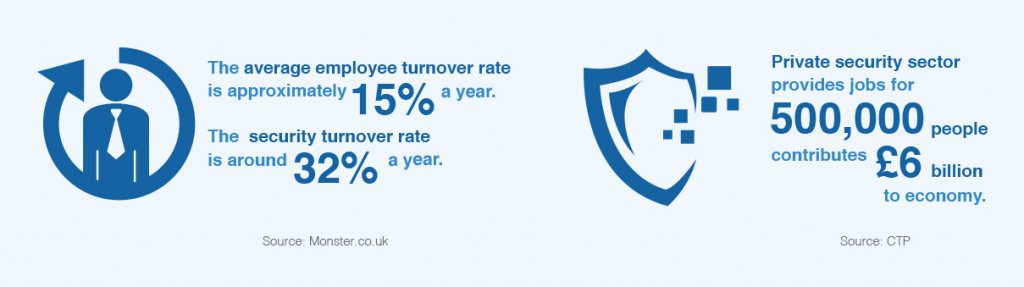
Roles vary within the sector, from maritime security and transit cash processors to consultants, investigators and security dog handlers. The skills and specialisations needed may include foreign languages, being in good physical condition and having the related training. Sourcing new employees is a real headache for recruiters who are struggling to reduce the critical turnover.
The monetary impact of an employee leaving, based on shorthand formulas and sources, is between 30% and 400% of their annual salary. However, the accurate cost of employee turnover is determined by a combination of various parameters. These include their current pay and performance, the workload that needs to be delegated to other colleagues plus recruiting and training.
Below is a scenario that includes the turnover cost estimation, as well as the possible savings and benefits arising from implementing a solution that will decrease the turnover rate. The scenario is calculated using a workforce of 150 employees and an annual turnover rate of 32%.
The monetary impact of an employee leaving, based on shorthand formulas and sources, is between 30% and 400% of their annual salary. However, the accurate cost of employee turnover is determined by a combination of various parameters. These include their current pay and performance, the workload that needs to be delegated to other colleagues plus recruiting and training.
Below is a scenario that includes the turnover cost estimation, as well as the possible savings and benefits arising from implementing a solution that will decrease the turnover rate. The scenario is calculated using a workforce of 150 employees and an annual turnover rate of 32%.
Staff Base of 125
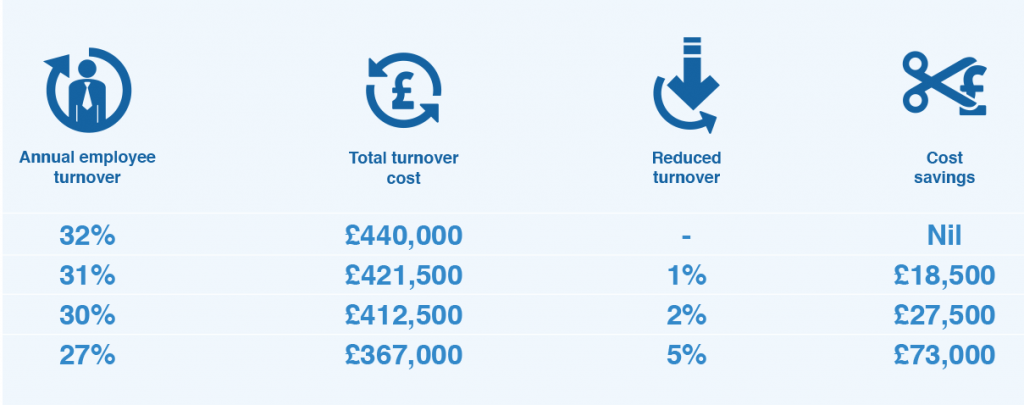
Based on the above, the savings that could arise for a company, by reducing the turnover rate even by a small percentage, are significant and quite extraordinary.
The question that emerges naturally is: “How is it possible to reduce employee turnover?”
There are some apparent retention tactics for every company, such as a more attractive remuneration package for employees, even as a counter-offer when they have handed in their notice. Another tactic that works proactively and has long-term benefits is providing employees with opportunities to develop in their roles and advance their careers. Employers with a healthy turnover would do well to amend working conditions and cultivate a teambuilding philosophy to help employees enhance their interpersonal relationships and their sense of belonging.
One of the most fundamental ways to retain your employees is by rewarding them. Perks and pensions are great tools for keeping staff and preventing them from seeking new career opportunities elsewhere. Offer your employees an attractive work package that upgrades their lifestyle, engages and motivates them and, consequently, reduce your turnover.
Centralus offers a targeted solution to the private security sector for the ultimate competitive advantage: an engaging workplace that retains top talent and reduces turnover rates. By joining our community, companies gain access to an array of blue chip perks for employees including 24/7 access to doctors, a confidential helpline and discounts on shopping, travel and leisure. We also provide workplace pensions so employees can secure themselves a flexible and rewarding retirement plan.
The question that emerges naturally is: “How is it possible to reduce employee turnover?”
There are some apparent retention tactics for every company, such as a more attractive remuneration package for employees, even as a counter-offer when they have handed in their notice. Another tactic that works proactively and has long-term benefits is providing employees with opportunities to develop in their roles and advance their careers. Employers with a healthy turnover would do well to amend working conditions and cultivate a teambuilding philosophy to help employees enhance their interpersonal relationships and their sense of belonging.
One of the most fundamental ways to retain your employees is by rewarding them. Perks and pensions are great tools for keeping staff and preventing them from seeking new career opportunities elsewhere. Offer your employees an attractive work package that upgrades their lifestyle, engages and motivates them and, consequently, reduce your turnover.
Centralus offers a targeted solution to the private security sector for the ultimate competitive advantage: an engaging workplace that retains top talent and reduces turnover rates. By joining our community, companies gain access to an array of blue chip perks for employees including 24/7 access to doctors, a confidential helpline and discounts on shopping, travel and leisure. We also provide workplace pensions so employees can secure themselves a flexible and rewarding retirement plan.

Call Centre Turnover: A Vicious Circle With No Easy Way Out
It’s a fact that employees are a company’s greatest asset. What happens, though, when they decide to quit a few months after they get hired? For the call centre industry, this is very common.
The numbers speak for themselves; call centres deal with a 26% employee turnover annually, whereas the average rate for the UK is 15%. According to CIPD, the average cost for the call centre staff turnover is over £6,000; a cost that reaches £9,000 for senior positions.
The numbers speak for themselves; call centres deal with a 26% employee turnover annually, whereas the average rate for the UK is 15%. According to CIPD, the average cost for the call centre staff turnover is over £6,000; a cost that reaches £9,000 for senior positions.

High levels of stress, excessive demands, unrealistic targets and strict monitoring of performance are some of the reasons why the call centre industry faces such a high turnover rate; consequently struggling with talent shortages, tight margins and pressure on costs and profits. Another key factor is that call centre agents enter the industry keeping in mind that they won’t be around for long; they don’t intend to stay. Managers are also aware of this fact. They don’t expect the employees to be around for a long time, nor do they feel the need to motivate them to do so. On the contrary, they are trying to “use” them as much as they can, push and micromanage their performance and productivity; inevitably burning them out and forcing them to quit. So, the vicious circle of turnover goes on and on.
Although a normal turnover can benefit a company, since it prevents employee stagnation and leaves space for labour flow, a high level of turnover is troubling and costly. The financial impact from the turnover, based on shorthand formulas, is between 30% and 400% of the annual salary of an employee. However, the accurate cost of employee turnover is determined by a combination of various parameters. When it comes to call centres, turnover harms a company’s productivity and profitability, especially if those who quit are top performers and long-serving employees. Using a staff base of 125, the table below demonstrates the savings that accumulate for a call centre that reduces the turnover rate even by a small percentage as significant.
Although a normal turnover can benefit a company, since it prevents employee stagnation and leaves space for labour flow, a high level of turnover is troubling and costly. The financial impact from the turnover, based on shorthand formulas, is between 30% and 400% of the annual salary of an employee. However, the accurate cost of employee turnover is determined by a combination of various parameters. When it comes to call centres, turnover harms a company’s productivity and profitability, especially if those who quit are top performers and long-serving employees. Using a staff base of 125, the table below demonstrates the savings that accumulate for a call centre that reduces the turnover rate even by a small percentage as significant.
Staff Base of 125
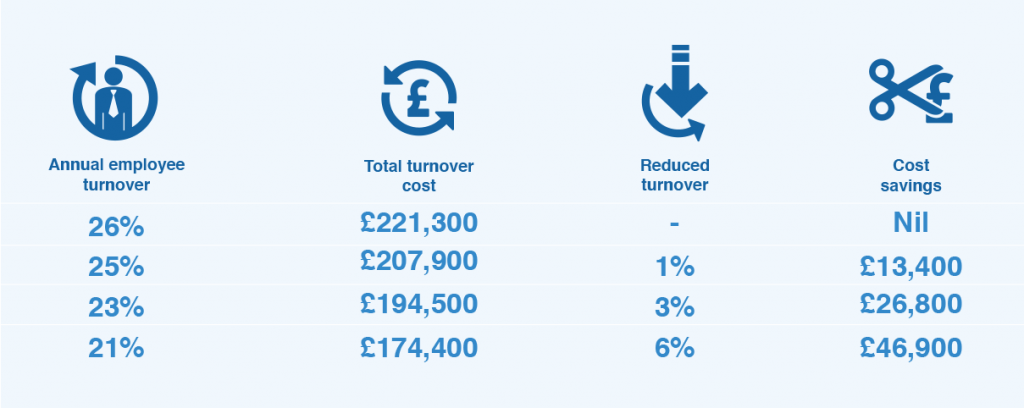
How could a call centre prevent its staff from leaving? How can this industry attract top talent, retain it and reduce its agent turnover rates? Apart from the usual retention tactics a company could use, such as attractive remuneration packages and opportunities for career advancement… engagement is the answer. Do the employees feel that their skills and experience are valued? Aside from permanent staff, temps also perform better if they feel valued, recognised and cared for.
There is a great option when aiming to retain your employees: perks and rewards. Perks and secure pension
schemes can prevent your workforce from seeking new employers, or at least thinking twice about doing so.
Centralus offers a targeted solution to the call centre industry for the ultimate competitive advantage: an engaging workplace that retains top talent and reduces turnover rates. By joining our community, companies gain an array of blue chip perks for employees including 24/7 access to doctors, a confidential helpline as well as discounts on shopping, travel and leisure. Our offer stands for both, permanent and temporary staff, in order to increase loyalty. We also provide workplace pensions so employees can secure themselves a flexible and rewarding retirement plan.
There is a great option when aiming to retain your employees: perks and rewards. Perks and secure pension
schemes can prevent your workforce from seeking new employers, or at least thinking twice about doing so.
Centralus offers a targeted solution to the call centre industry for the ultimate competitive advantage: an engaging workplace that retains top talent and reduces turnover rates. By joining our community, companies gain an array of blue chip perks for employees including 24/7 access to doctors, a confidential helpline as well as discounts on shopping, travel and leisure. Our offer stands for both, permanent and temporary staff, in order to increase loyalty. We also provide workplace pensions so employees can secure themselves a flexible and rewarding retirement plan.

The Future of Employment is Here! Is your business future – proof?
Do free cupcakes affect the growth of your business? Love comes from the heart but passes through the stomach. So does the performance of employees in the 21st century*. Perks and a new approach of the employer-employee relationship carve the future of employment today. (Free cupcakes included.)

The old certainties of employment, the relationship between employer and employee are vanishing, swept by the tides of tomorrow. Some might say that insecurity replaces security and flexibility replaces permanence. The ones who see further can clearly recognise the end of one system and the birth of another, marked by the freedom to work wherever, whenever and however they please.
How do you ensure your business and your people that you are capable of eliminating risks and ready to ride the waves of opportunity?
Employers and employees watch their relationship shape anew, as their goals, expectations and perspectives develop in an unprecedented speed; keeping up with changes and evolving to more flexible and demanding forms. Employers know that in order to guarantee their business growth, they need to employ people with exceptional skills. People who, on their part, know that they are skilled and bargain their talent and competencies in a time where workforce mobility is on the rise.
The employer of the future will have to do more than just focus on business growth, innovations and staying ahead of the competition. The employers of the future must be energetic, empathetic and engaged; mirroring their employees’ needs, responding to them, fostering the most positive sides of their personality, rewarding them, thus keeping them committed, motivated and productive.
In the dawn of the Industrial Revolution, people argued that by reducing working hours and feeding the workers more, their productivity would increase. They were absolutely right and, in the same spirit, the employer of tomorrow already knows that the changes that have to be made will be in his best interest.
Instead of striving to juggle with the rising challenges, the employer has an ace up his sleeve that allows him to stay focused on the performance, strategy and expansion of his business: outsourcing.
Companies that offer dedicated services lift tons of complicated administrative burdens, relieving HR departments and managing officers, as well as CEO’s, from pains that hold back business growth. Moreover, they provide their clients with a series of admirable benefits and perks that have been proven to increase employee dedication, performance and well-being.
Elements of tomorrow’s workforce can already be outlined just by looking at the behavior of millennials (born between 1980 and 1996). It can be said, roughly, that millennials shop around for jobs that are best aligned with their needs and life goals. Statistics reveal that:
How do you ensure your business and your people that you are capable of eliminating risks and ready to ride the waves of opportunity?
Employers and employees watch their relationship shape anew, as their goals, expectations and perspectives develop in an unprecedented speed; keeping up with changes and evolving to more flexible and demanding forms. Employers know that in order to guarantee their business growth, they need to employ people with exceptional skills. People who, on their part, know that they are skilled and bargain their talent and competencies in a time where workforce mobility is on the rise.
The employer of the future will have to do more than just focus on business growth, innovations and staying ahead of the competition. The employers of the future must be energetic, empathetic and engaged; mirroring their employees’ needs, responding to them, fostering the most positive sides of their personality, rewarding them, thus keeping them committed, motivated and productive.
In the dawn of the Industrial Revolution, people argued that by reducing working hours and feeding the workers more, their productivity would increase. They were absolutely right and, in the same spirit, the employer of tomorrow already knows that the changes that have to be made will be in his best interest.
Instead of striving to juggle with the rising challenges, the employer has an ace up his sleeve that allows him to stay focused on the performance, strategy and expansion of his business: outsourcing.
Companies that offer dedicated services lift tons of complicated administrative burdens, relieving HR departments and managing officers, as well as CEO’s, from pains that hold back business growth. Moreover, they provide their clients with a series of admirable benefits and perks that have been proven to increase employee dedication, performance and well-being.
Elements of tomorrow’s workforce can already be outlined just by looking at the behavior of millennials (born between 1980 and 1996). It can be said, roughly, that millennials shop around for jobs that are best aligned with their needs and life goals. Statistics reveal that:



Tomorrow is already happening, and some of these people will have a desk at the office while others will be working from home or from a coffee shop on the other side of the globe. Moreover, perks such as shopping discounts, healthcare and pension planning will eventually be considered an essential factor for retaining top employees.
Still, they will be somebody’s employees, and that someone will have to focus on orchestrating diverse teams and personalities, overlooking tasks and challenges related to maintaining the team spirit and motivation to their maximum extent.
Trusting the handling of administrative obligations such as payroll, compliance, and employment law assistance was a common practice to untie the employers’ hands and let them focus on expanding their businesses. But this was the past. The delicate handling of a highly skilled workforce in order to ensure their loyalty, satisfaction and motivation that inevitably leads to high performance and unparalleled productivity is the next challenge.
Organisations that manage to combine the conduction of dull administrative tasks with the demanding feat of keeping their clients’ employees happy and triggered will spearhead the future of the market of outsourcing HR consultancy agencies. Keeping them happy means providing them with the bulk of perks that improve their lives, and fulfil their hopes and expectations. So, when part of these hopes and expectations are supported and covered by their broader working environment, their loyalty is unquestioned, their drive becomes unstoppable and their productivity is unmatched..
Having outsourced the dull administration, along with the support of professional consultants, employers are left undistracted to step into the future. The employer of tomorrow has to bring the entire team into the bigger conversation: “Why we do what we do”. Instilling the team with the values and the vision is a priceless boost. Efficient performance and strategy will depend on employers who have conquered the hearts and minds of their teams before winning the hearts and minds of their clients.
It’s all about the human approach. It’s not a 21st century invention or shift, it’s just the next step to a chain of changes revolving around employment. It started with the abolition of slavery, transformed into better working conditions, and is now moulding to new forms that take every employee’s talents and life scope into consideration, doing the best for them and, subsequently, getting the best out of them.
The company of the future leaves the traditional hierarchy behind and is organised more like a social network. A small, efficient core of its own employees, supported by external associates will be the shape of success.
Employees of the future are individuals who expect their talents and skills to be rewarded, recognised and cultivated. They will not sacrifice their personal happiness for their career. Instead, they view the harmonical interweaving of both factors as the optimum scenario.
The employer of the future will be a figure drawn from sagas, a warrior-poet, or better, a communications expert with highly developed social skills – a visionary. The Future of Employment will not be built by machines. It is already being shaped by humans who think as humans, act as humans and care for humans.
Still, they will be somebody’s employees, and that someone will have to focus on orchestrating diverse teams and personalities, overlooking tasks and challenges related to maintaining the team spirit and motivation to their maximum extent.
Trusting the handling of administrative obligations such as payroll, compliance, and employment law assistance was a common practice to untie the employers’ hands and let them focus on expanding their businesses. But this was the past. The delicate handling of a highly skilled workforce in order to ensure their loyalty, satisfaction and motivation that inevitably leads to high performance and unparalleled productivity is the next challenge.
Organisations that manage to combine the conduction of dull administrative tasks with the demanding feat of keeping their clients’ employees happy and triggered will spearhead the future of the market of outsourcing HR consultancy agencies. Keeping them happy means providing them with the bulk of perks that improve their lives, and fulfil their hopes and expectations. So, when part of these hopes and expectations are supported and covered by their broader working environment, their loyalty is unquestioned, their drive becomes unstoppable and their productivity is unmatched..
Having outsourced the dull administration, along with the support of professional consultants, employers are left undistracted to step into the future. The employer of tomorrow has to bring the entire team into the bigger conversation: “Why we do what we do”. Instilling the team with the values and the vision is a priceless boost. Efficient performance and strategy will depend on employers who have conquered the hearts and minds of their teams before winning the hearts and minds of their clients.
It’s all about the human approach. It’s not a 21st century invention or shift, it’s just the next step to a chain of changes revolving around employment. It started with the abolition of slavery, transformed into better working conditions, and is now moulding to new forms that take every employee’s talents and life scope into consideration, doing the best for them and, subsequently, getting the best out of them.
The company of the future leaves the traditional hierarchy behind and is organised more like a social network. A small, efficient core of its own employees, supported by external associates will be the shape of success.
Employees of the future are individuals who expect their talents and skills to be rewarded, recognised and cultivated. They will not sacrifice their personal happiness for their career. Instead, they view the harmonical interweaving of both factors as the optimum scenario.
The employer of the future will be a figure drawn from sagas, a warrior-poet, or better, a communications expert with highly developed social skills – a visionary. The Future of Employment will not be built by machines. It is already being shaped by humans who think as humans, act as humans and care for humans.








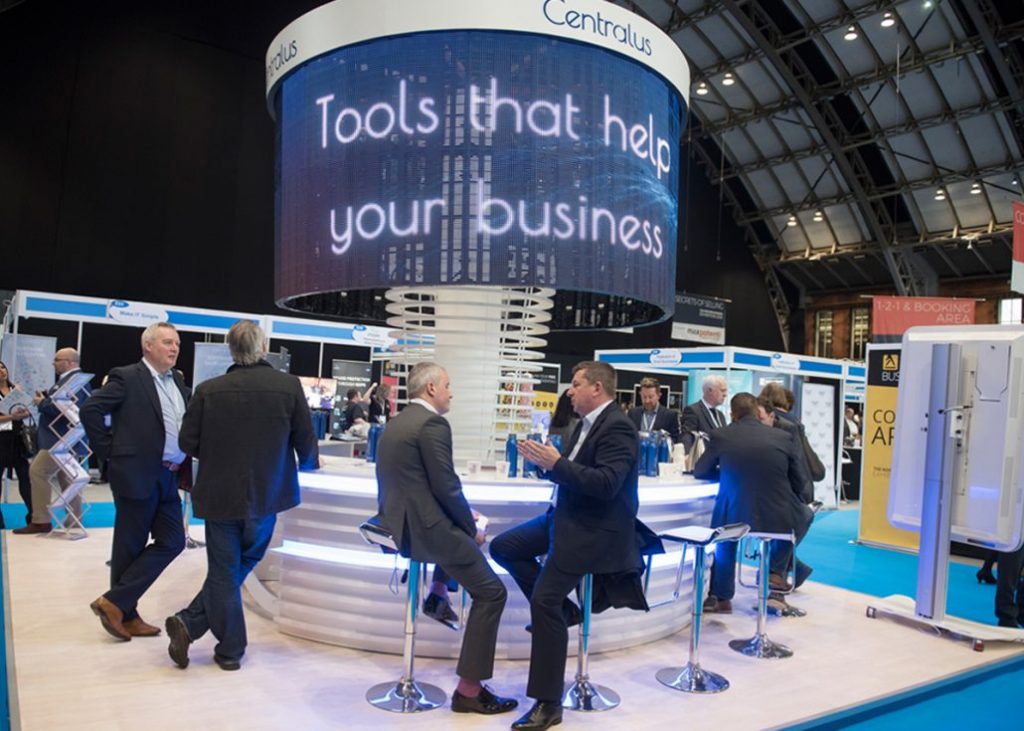
The Northern Business Expo 2018
We did it again! Centralus rocked the Northern Business Exhibition at the Manchester Central on the 18th and 19th of April.
During the 2-day event, business owners, CEOs, directors and senior managers gathered around our stand and enjoyed our unique employee engagement approach through a fascinating experience that addressed all five senses.
Taste, sight, touch, smell and sound blended together, creating the enhanced reality we developed for the future of the workplace.
We were given the golden opportunity to present our two new products we specially designed for employers and employees:
iEngagement – the tools that help businesses achieve outstanding employee engagement, leading to higher productivity, and WOW – The Wonderful Workplace, an amazing work-life engagement experience that motivates and empowers employees to be happy in an upbeat, fun and positive environment.
On the first day of the exhibition, half an hour was more than enough for David Callaghan, our Chief Executive Officer, to capture the visitors’ attention with his illuminating presentation “Transforming Business Through Employee Engagement”.
Our stand attracted visitors like swarming bees to a honeypot -we hope it wasn’t just because of our colourful jellybeans.
They were very eager to discover how we innovate recruitment by creating the environment that fosters happy and engaged employees.
Centralus continuously reveals its dynamic presence in corporate events. We look forward to seeing you at our next event: The Business Show – 16 & 17 May, at the Excel London
For further information please visit our website www.centralus.co.uk or call one of our experts at 0800 211 8109.
During the 2-day event, business owners, CEOs, directors and senior managers gathered around our stand and enjoyed our unique employee engagement approach through a fascinating experience that addressed all five senses.
Taste, sight, touch, smell and sound blended together, creating the enhanced reality we developed for the future of the workplace.
We were given the golden opportunity to present our two new products we specially designed for employers and employees:
iEngagement – the tools that help businesses achieve outstanding employee engagement, leading to higher productivity, and WOW – The Wonderful Workplace, an amazing work-life engagement experience that motivates and empowers employees to be happy in an upbeat, fun and positive environment.
On the first day of the exhibition, half an hour was more than enough for David Callaghan, our Chief Executive Officer, to capture the visitors’ attention with his illuminating presentation “Transforming Business Through Employee Engagement”.
Our stand attracted visitors like swarming bees to a honeypot -we hope it wasn’t just because of our colourful jellybeans.
They were very eager to discover how we innovate recruitment by creating the environment that fosters happy and engaged employees.
Centralus continuously reveals its dynamic presence in corporate events. We look forward to seeing you at our next event: The Business Show – 16 & 17 May, at the Excel London
For further information please visit our website www.centralus.co.uk or call one of our experts at 0800 211 8109.
Centralus at the CIPD Annual Conference and Exhibition 2017
Once again, Centralus successfully participated in the 70th CIPD Annual Conference and Exhibition that was held at the Manchester Central on the 8th and 9th of November. During the 2-day event, HR specialists, business partners and managers gathered around our stand and felt our unique employee engagement approach through a specially designed experience that addressed all five senses. Taste, sight, touch, smell and sound blended together, creating the enhanced reality we developed for the future of the workplace. Visitors were very interested and eager to find out more on how to become preferred employers of choice, surrounded by happy and engaged employees. We presented the exceptional services Centralus can provide and got the chance to share our vision with them. The exclusive package we designed includes tailor made perks that are normally provided by big businesses to employees. VIP Lifestyle (a discount portal on high-street brands, insurance), VIP Wellbeing (health assessments, confidential helpline) VIP Medical Care (doctor 24/7, care support & medical specialist) along with a rewarding personal pension plan, reserving a future worthy of their productivity and dedication. Centralus continuously reveals its dynamic presence in corporate events. We look forward to meeting you in person at our next 2-day event, The Recruitment Agency Expo which will take place at the London Olympia on the 31st of January 2018 – the #1 recruitment industry event in the UK.
For further information call one of our experts at 0800 211 8109.
For further information call one of our experts at 0800 211 8109.

Fostering Training, Rewarding Excellence
The Global Recruiter Awards recognise the achievements of the innovators, the high flyers, the persistent performers and the dedicated professionals in the industry, those that disrupt, develop and shape what is to come in the recruitment sector through their outstanding work.
Excellence is achieved by training, the backbone of progress. Centralus is proudly sponsoring the In-House Training Award at The Global Recruiter Awards on the 29th of June in London.
The nominees for the Best In-House Training Award are:
Amoria Bond
Energize Recruitment Solutions
Reuben Sinclair
SEC Recruitment
Serocor Group
Congratulations to all on their nominations!
We take pride in shaping the future of employment, and this award reflects part of the workplace of tomorrow – where people stay engaged, motivated, self-driven and eager to excel, to evolve, to upgrade their skills, unlock their potential, leading their organisations to excellence.
Competition is fierce and agencies that invest in training not only adapt to the increasingly demanding market, but also carve out the talent-driven future.
Centralus’ own in-house training has established our organisation’s responses to the challenges our customers face. Our consultancy expertise is attuned to their needs, designed to launch growth by removing employment burdens and by providing the tools and services that curtail trouble and boost profit for agencies.
We offer the tools and perks that guarantee that agencies joining us are free of administrative and legislative tasks, and their people stay engaged, motivated and creative.
The In-House Training Award embodies the spirit of learning and excellence we cherish. Our sponsorship is an expression of our vision for the future of our industry and how we honour those who share this vision. The future of employment is here!
Excellence is achieved by training, the backbone of progress. Centralus is proudly sponsoring the In-House Training Award at The Global Recruiter Awards on the 29th of June in London.
The nominees for the Best In-House Training Award are:
Amoria Bond
Energize Recruitment Solutions
Reuben Sinclair
SEC Recruitment
Serocor Group
Congratulations to all on their nominations!
We take pride in shaping the future of employment, and this award reflects part of the workplace of tomorrow – where people stay engaged, motivated, self-driven and eager to excel, to evolve, to upgrade their skills, unlock their potential, leading their organisations to excellence.
Competition is fierce and agencies that invest in training not only adapt to the increasingly demanding market, but also carve out the talent-driven future.
Centralus’ own in-house training has established our organisation’s responses to the challenges our customers face. Our consultancy expertise is attuned to their needs, designed to launch growth by removing employment burdens and by providing the tools and services that curtail trouble and boost profit for agencies.
We offer the tools and perks that guarantee that agencies joining us are free of administrative and legislative tasks, and their people stay engaged, motivated and creative.
The In-House Training Award embodies the spirit of learning and excellence we cherish. Our sponsorship is an expression of our vision for the future of our industry and how we honour those who share this vision. The future of employment is here!
Centralus Supports The Springboard Charity at the EB Live 2017
Once again, Centralus successfully participated in the EB Live that was held at the London Olympia on the 10th and 11th of October.
This year, Centralus took the initiative of donating to an admirable charity that helps young adults achieve their potential and encourages unemployed people, of any age, to work. A donation of £2 was made per visitor who kindly shared, liked and commented on our stand through their social media. With great pride, we managed to raise £3,992 for The Springboard Charity and Springboard UK.
Throughout the 2-day event, many CEOs, agencies and recruitment suppliers gathered and had the opportunity to experience the future of employment through our VIP Perks. Visitors were very interested and eager to find out more on how to become employers of choice, surrounded by happy and engaged employees. We presented the exceptional services Centralus can provide and got the chance to share our vision with them.
Employers had the opportunity to discover how Centralus VIP Perks can make a significant change in their employees’ everyday life. Our unique package includes tailor made perks that are normally provided by big businesses – VIP Lifestyle (discount outlet on high-street brands, insurance), VIP Wellbeing (health assessments, confidential helpline) VIP Medical Care (doctor 24/7, care support & medical specialist) along with a rewarding personal pension plan, reserving a future worthy of their productivity and dedication.
Centralus continuously reveals its dynamic presence in corporate events.
We look forward to meeting you in person at our upcoming event, which reflects exactly what we do. Embracing the New World of Work is the theme at CIPD’s Annual Conference and Exhibition at Manchester Central on the 8th & 9th of November.
For further information please visit our website www.centralus.co.uk or call one of our experts at 0800 211 8109.
This year, Centralus took the initiative of donating to an admirable charity that helps young adults achieve their potential and encourages unemployed people, of any age, to work. A donation of £2 was made per visitor who kindly shared, liked and commented on our stand through their social media. With great pride, we managed to raise £3,992 for The Springboard Charity and Springboard UK.
Throughout the 2-day event, many CEOs, agencies and recruitment suppliers gathered and had the opportunity to experience the future of employment through our VIP Perks. Visitors were very interested and eager to find out more on how to become employers of choice, surrounded by happy and engaged employees. We presented the exceptional services Centralus can provide and got the chance to share our vision with them.
Employers had the opportunity to discover how Centralus VIP Perks can make a significant change in their employees’ everyday life. Our unique package includes tailor made perks that are normally provided by big businesses – VIP Lifestyle (discount outlet on high-street brands, insurance), VIP Wellbeing (health assessments, confidential helpline) VIP Medical Care (doctor 24/7, care support & medical specialist) along with a rewarding personal pension plan, reserving a future worthy of their productivity and dedication.
Centralus continuously reveals its dynamic presence in corporate events.
We look forward to meeting you in person at our upcoming event, which reflects exactly what we do. Embracing the New World of Work is the theme at CIPD’s Annual Conference and Exhibition at Manchester Central on the 8th & 9th of November.
For further information please visit our website www.centralus.co.uk or call one of our experts at 0800 211 8109.
OUR PARTNERS










OUR PARTNERS: